Tag Archives: Coffee

Cafe Hounding: Juan Valdez & Cafe Bonsai – Santa Marta, Colombia

Juan Valdez in Santa Marta city center near the main port
Cafe Bonsai in Taganga (little bay fishing town slightly east of Santa Marta)

Collage ala Santa Marta

JUAN VALDEZ – Santa Marta

In my relatively limited experience, providing high quality coffee in terribly hot and humid conditions is usually an EPIC FAIL based on my experience with several of the coffee barons in Managua, Nicaragua.

That said, Juan Valdez has managed to keep its product consistently above average (though not excellent) everywhere that I have tried it.  This includes the city center in Santa Marta, Colombia.  They also provide paying customers with 30 minutes of free wifi (if requested) and have a variety of tasty baked treats to go along with their splendid coffees.  They probably do better business with their cold drinks here in Santa Marta, but also do a decent job of selling and preparing their hot ‘pod’ drinks and single and double shot espresso drinks. My girlfriend thoroughly enjoyed their Cheese/Bread Stick (Palito de Queso) and also the Almojabana (which reminded her of the delicious Brazilian treat Pao de Queijo).

The seating at a Juan Valdez is always comfortable and intelligently situated to provide for the right combination of privacy and social interaction – a key element of Colombian culture.

The Juan Valdez in Santa Marta attracts the local color – musicians and other interesting characters – who come to entertain the heavily foreign  (read: German) tourists who setup camp here to practice their Spanish and regroup after excursions in and around the Department of Magdalena. Overall Juan Valdez rarely fails to deliver on the customer expectation for a special and above average experience with above average coffee.  Oma cannot compete with Juan Valdez on a national level and this fact is only cemented by positive experiences like the ones I had at the Juan Valdez in Santa Marta. I hope they keep up the good work – and continue to send good merchandise to the DC shops so I can continue to buy their shirts and travel mugs when visiting the Organization of American States!

CAFE BONSAI – Taganga

One such tourist destination in Magdalena is the small fishing town east of Santa Marta by the name of Taganga.  Taganga is most known for offering affordable and decent quality scuba diving lessons/certification classes to tourists traveling through this tropical outpost in Colombia.

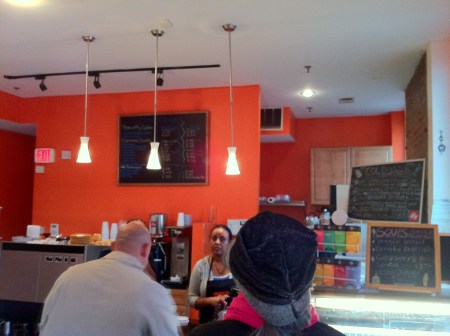
In Taganga, my friend and I happened upon the self-proclaimed “Nicest Little Coffee Shop in the Southern Hemisphere” – which I had to put to the test.  We meandered in, after being followed all the way to the door by a local stray dog looking for some air condition and table scraps. The atmosphere was definitely cool, bohemian, and welcoming to the backpacking tourist hailing from Europe (judging by our company inside).  The Left-leaning Aterciopelados blared on the radio and our bohemian waitress/barista took our order after we evaluated their very lengthy menu on the wall for several minutes.

My first inclination was to request the gold standard for a coffee shop – espresso please.

But, I hinted to my friend that the machine was not running (likely to save electricity) and that if they were to pull my shot immediately after turning on the machine, it would be of the worst quality with no crema whatsoever.  My prediction was 100% correct – despite the coffee being from a local cooperative of indigenous growers who sell their coffee through designated ‘Casa Indigena’ – indigenous cooperative trade associations (such as this one http://intermundos.org/sierra_nevada1.htm). I suspect that the coffee quality is better than my espresso reflected, so I encourage additional research.

On a side note, the iced tea that my friend ordered was also surprisingly unpleasant.  Sadly, it appears that the biggest sell here was that they have English speaking staff, English marketing materials, free wi-fi (that cuts out a lot), and a HUGE menu. Quantity, not quality. Also of note, the prices were expensive even relative to coffee shops in DC and California. Positively, the cozy bohemian feel becomes quite endearing and familiar as an ex-pat in Colombia.

Next time I visit Taganga, I will probably stick with the fresh fish and fresh juices consumed  under a straw hut overlooking the bay. Santa Marta and the surrounding areas are quaint, safe and beautiful. I highly suggest visiting!

Looking out over the bay in Taganga while waiting for my freshly caught Red Snapper to be served.

Another interesting side note – much of this little town’s wealth came from ‘seed money’ in the 70s as a result of the lucrative illicit marijuana trade to the US. Local traquetos laundered the money by investing in real estate, agro-industry, and boosting the local tourism industry. The U.S. market has long since moved to closer producers (British Columbia, Mexico, California) to meet domestic demand and Taganga appears to rely mostly on tourism as its lifeblood. Cheers.

Cafe Hounding: Cafe Don Pedro – Bogota, Colombia

Carrera 11A # 89-48
Bogota – Colombia
http://www.cafedonpedro.com/primera_del_Cafe.htm

Don Pedro's interior from the back room looking out towards the adjoined bakery run by Pedro's wife.

Cafe Don Pedro is one of those places that began Maher Hound’s entire journey into the coffee world.  An exercise in objectivity would be senseless in this post considering my first encounter with the wonderful Colombian grown stimulant known as Cafe Don Pedro began in the late nineties after my father received a pound as a gift from a friend stationed at the US Embassy in Bogota.  At the time my family did not find the coffee particularly amazing and I was too young to have taken up the habit of coffee drinking full-time yet.

Several years later, after being reintroduced to Colombian coffee through a chocolate covered experience with Oma coffee, I found my way down to Colombia and into the storied retail location of Cafe Don Pedro on Calle 90 where it intersects Carrera 11A.  Beyond having one of the most folkloric, traditional coffee themed interior designs I have ever seen in a coffee shop; Cafe Don Pedro had very well trained and highly knowledgeable staff that were able to describe everything about the entire supply chain process of a coffee plant/bean and how to prepare beverages with care and with style.

My first visit to Cafe Don Pedro in the flesh was in 2006.  This was before I had been properly introduced to cupping and understanding the careful and lengthy process of training one’s palate to distinguish subtle discrepancies in the flavor profile of different beans and brews.  Even at this early juncture of my coffee loving career, I knew I had come across a truly amazing quality of coffee.  Upon my departure from Colombia several months later I carried several pounds of the delicious substance with me (beans were packaged according to their Department (a national sub-unit similar to a State) of origin). The most well-rounded beans sold by Don Pedro were probably the Cudinamarca blend – taken from the region immediately surrounding Bogota.  The most unique and distinctly (although quite mild) beans were those from Huila, found south of Neiva heading towards the Colombia-Ecuador border on the 45 highway. The Huila beans – last time I tried them in 2008 – had a vanilla and nutty undertone in the finish that was preceded by bright orange acidity in the initial sip.

Upon my return to Colombia in 2008, I made another stop at Don Pedro and enjoyed the comfortable ambiance and coffee of the shop.  Did I mention that, because they roast coffee every day right in the front of the shop, there is an overwhelmingly pleasant aroma of fresh roasted coffee that greets each customer upon entering the shop?

In 2008 I sat down and discussed the business – both the beauty of owning one’s own specialty coffee retail location in a country dominated by the Juan Valdez and FEDERCAFE image AND the problems associated with trying to leverage the international recognition of the Juan Valdez label while trying to directly export one’s own brand to international markets.  It appears that Pedro de Narveaz is still wrapped up in a legal dispute with the National Coffee Growers Federation in Colombia and this will likely – due to the political clout and financial resources of the Federation – end badly for our beloved Don Pedro.

Despite these facts, his business does incredibly well just by selling to the  Bogota equivalent of Washington, D.C.’s ‘Embassy Row’ with high praise coming from the US Embassy in Bogota and his own product positioning in Bogota’s El Dorado International Airport for those hoping to grab a bag of Don Pedro before hopping on the plane. I returned yet again to Don Pedro in July 2010 to grab five pounds and sample a delicious espresso with my girlfriend.  As she enjoyed her cappuccino with ‘fluffy foam’ and delicious coffee cookie treats, I reminisced about the more than four years of coffee patronage at this wonderful location in downtown Bogota.  Now, with the store moving down the street into a smaller shop on Calle 89 with 11A, I am both saddened and excited about the future of the Cafe Don Pedro experience.  The new commerce brought to this neighborhood by the incoming Mall will definitely boost foot traffic in and around Cafe Don Pedro, but it will also dramatically alter the quiet and charming experience that this neighborhood offered the older Bogotano crowd looking for an elegant cafe to discuss Colombian culture, society, politics and – most importantly – coffee.


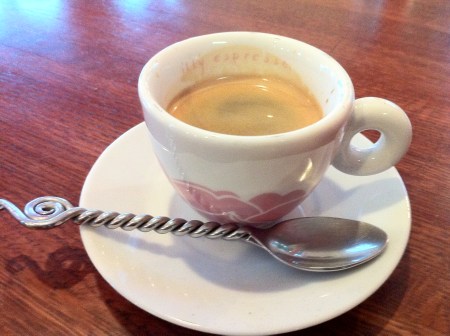
Gently kissing this cup of C-marca espresso blend goodnight on my last evening in Bogota in July 2010.

Cafe Hounding: Ozzie’s Coffee Bar – Old Forge, NY

3019 Main St.
Old Forge, New York

As many of those who relish in a fresh cup of specialty coffee stumble across this page in ‘google’ searches for the next best thing in their locale, I stumbled across Ozzie’s Coffee Bar in Old Forge, New York while on vacation with family.  Often when traveling, one must take what they can get when it comes to getting the daily brew of coffee.

During my recent visit to Old Forge, I expected that I would not find anything worthy of Cafe Hound mention given the remote location and *assumed* lack of access to high quality roasters.  My assumption proved wrong the moment I walked through the doors of Ozzie’s Coffee Bar.

Ozzie’s customer service was yet another perk of this pleasant coffee cabin nestled into the quaint Adirondack town of Old Forge, New York.

I entered in search of free Wifi so that my friend and I could get some work done in between kayaking on the beautiful lakes of the Adirondack Mountains – only to find that there was no wifi available in this quaint shop. Although I nearly darted out the door upon learning of the lack of wifi, I took the plunge and ordered a standard double espresso to test their bean and barista quality.

My first impression was less than optimum given the fact that they served me a watery espresso in a large to-go coffee cup… but… I cleared my mind and took in the aroma.  To my surprise the aroma was fresh, earthy with hints of chocolate.  Next, I sipped in some of the semi-frothy crema that found its way on top of this drink.  It was pretty decent – made with well roasted and well preserved (i.e. relatively fresh) beans.  My only gripe is that the drink was too watered down because the barista intentionally over-pulled the shot (correctly assuming that the average consumer wants more liquid rather than more taste).

My friend ordered a chai latte (hot) and was also very pleasantly surprised.  I tasted her drink and found that it was made with high quality ingredients and was well prepared.  What a pleasant surprise.

The following day I returned to order another espresso (this time made with less than half the previous amount of water) and my friend ordered a skim cappuccino.  Both drinks were superb and thus I had to ask the baristas where the beans were from. I also asked for the owners information since I didn’t see her in the shop.

Albeit not that surprisingly, the beans used at Ozzie’s are not locally roasted.  Instead, the owner, Kristy Sutherland, prefers to create her own custom blend through a wholesale purchasing partnership with Aroma Coffee Roast in Larchmont, New York. Aroma is a known entity in the world of specialty roasters and continues to use a 12 KG roaster in order to achieve the careful control of each batch roasted on a daily basis.

In addition to splendid coffee, Ozzie’s also locally sources a variety of tasty treats, panini, sandwiches, salads and baked goods on a daily basis.  Cafe Hound promotes both an excursion to the beautiful Adirondack Mountains of upstate New York and a stop by Ozzie’s Coffee Bar along the way. We guarantee that there you will find plenty of hidden gems and scenic views along the way.

Order Now!!! Ano Novo 2010 Blend by Kris/Maher

For information and order, contact maher@cafehound.com or krislert@cafehound.com

In tribute to the new year, Cafe Hound presents to you the ANO NOVO 2010 Blend. Ano Novo means New Year in Portuguese and reflects our appreciation to Novo Coffee in Denver, Colorado, who perfectly roasted the beans for us. Concocted by Matthew Maher and Krislert Samphantharak, the blend mixes the best seasonal fair-trade and organic coffees of South America and Africa to provide a sophisticated, bright, and balanced flavor profile good for drip, press, or espresso brewing. The blend will give you a perfect beginning of 2010. All net proceeds will go to charity.

Specific coffees found in our blend include:

Amaro Gayo Sun-Dried: Amaro, Ethiopia – Full body with a grassy overtone and nuances of strawberry, apple, chocolate and unripe banana.

- San Rafael: Concordia, Colombia – This coffee has a strong acidity (tangerine nuances) followed by smooth finishing woody nuances. Very bright.  The coffee comes from the San Rafael estate of the Concordia municipality in the Department of Antioquia in Colombia. Maher has personally visited a number of coffee farms in this region of Colombia.

Kenya Gatina: Nyeri, Kenya – A woody well balanced coffee with blueberry undertones that compliment the brighter elements of the previously mentioned coffees.  This coffee is quite different than the Ndaironi region releases that were on the market in mid-2009 and is far too berriful as a single-origin.

Ojo de Agua: Volcan, Panama – Very balanced  mild citrus nuance with very silky finish.  Mixture of peanut and chocolaty nuances in the aftertaste.  At first appears uninteresting next to the sun-dried but in the end wins out on its “drinkability” and balanced finish. Novo has shared some additional details on the Ojo de Agua coffee from the Finca Hartmann in Panama.

“Some of the hardest-working and most environmentally committed coffee producers in the world, the three generations currently represented at Finca Hartmann all have a hand in daily operations. Much of the family’s land is primary forest and rests contiguous with the enormous Parque Nacional La Amistad, Central America’s largest national park. Despite uncountable offers to cut the forest for large monetary gain over decades, the Hartmanns remain committed to a future of coffee in balance with nature. The Hartmanns have a cupping lab on site and are leaders in coffee production for quality. Their expertise has been enjoyed beyond their own farm as they act as consultants for many Panamanian and other Latin American coffee producers.”

For ordering information please contact maher@cafehound.com . We encourage you to donate $10 for each half pound of coffee that you order (before shipping if you want it shipped).  As we manage the legal obstacles for setting up money transfers to our foundation partners in Colombia, Guatemala, Brazil, Nicaragua, Thailand, Indonesia and Vietnam – we will be giving all profit from the ANO NOVO 2010 Blend to a local food bank in Arlington, Virginia.  We will only have a limited amount of this very special blend so please place your order now, before it is too late!

Regards,

- The Hounds

Coffee entrepreneur and Maher Hound at farmer Horacio Montoya's farm Alto del Naranjo in Caldas, Colombia (2008).

Beyond Coffee: Prevent Cancer. Drink Coffee.

Having a few more cups of coffee and running that extra mile each day can reduce a man’s risk of dying of prostate cancer, two studies indicate.

The case for coffee and physical activity as prostate cancer preventatives is far from proven, according to the research reported Tuesday at an American Association for Cancer Research meeting in Houston. But data from the Health Professionals Follow-Up Study show a clear association with both daily activities.

“I wouldn’t recommend that people change their coffee-drinking habits based on this study,” said Kathryn M. Wilson, a research fellow in epidemiology at the Harvard School of Public Health, and lead author of one report. “But if you like coffee, there is no compelling reason to cut back at this point.”

Her data on the nearly 50,000 men in the study showed how common a diagnosis of prostate cancer has become since widespread screening began. In the 20 years from 1986 to 2006, 4,975 cases of prostate cancer were diagnosed, affecting just about 10 percent of the men in the study.

But only 846 of those cancers were life-threatening, because they had spread beyond the prostate gland or were growing aggressively, Wilson said. And while the study found just a weak relationship between consumption of six or more cups of coffee a day and a reduced risk of all forms of prostate cancer (down about 19 percent), the reduction for the aggressive form was much more marked — 41 percent.

And there was a clear relationship between the amount of coffee consumed and prostate cancer risk, Wilson said: “The more coffee you drank, the more effect we saw.”

The caffeine in coffee doesn’t seem to be the link, since the same reduction was seen for consumption of decaffeinated coffee, she said. Instead, “it has something to do with insulin and glucose metabolism,” Wilson said. “A number of studies have found that coffee is associated with a reduced risk of diabetes.”

This study is just a starting point for establishing a relationship between coffee and prostate cancer, Wilson stressed. “At this point, we would just like to confirm whether it exists in different populations,” she said. “We hope that this study drives more research so that we really know what is going on.”

The other study, by Stacey A. Kenfield, a research associate at the Harvard School of Public Health, looked at the levels of physical activity among 2,686 men in the study who were diagnosed with prostate cancer. It found, as many other studies have, that exercise is good for overall health, with a 35 percent lower death rate for men who reported three or more hours a week of vigorous physical activity, such as jogging, biking, swimming or playing tennis.

And the death rate from prostate cancer for men who exercised vigorously was 12 percent lower than for those who didn’t — a figure that did not quite reach the level of statistical significance because the numbers were small, Kenfield explained.

Nevertheless, “this is the first study to show an effect of physical activity not only on overall survival, but on prostate cancer survival,” she said.

It’s already well known how physical activity reduces overall mortality, Kenfield said. “It affects immune function and reduces inflammation, among the major processes involved. But it’s not clear yet how it is related to prostate cancer and survival.”

Source: HealthDay News 12/9/2009