Cafe Hounding: Juan Valdez & Cafe Bonsai – Santa Marta, Colombia

Juan Valdez in Santa Marta city center near the main port
Cafe Bonsai in Taganga (little bay fishing town slightly east of Santa Marta)

Collage ala Santa Marta

JUAN VALDEZ – Santa Marta

In my relatively limited experience, providing high quality coffee in terribly hot and humid conditions is usually an EPIC FAIL based on my experience with several of the coffee barons in Managua, Nicaragua.

That said, Juan Valdez has managed to keep its product consistently above average (though not excellent) everywhere that I have tried it.  This includes the city center in Santa Marta, Colombia.  They also provide paying customers with 30 minutes of free wifi (if requested) and have a variety of tasty baked treats to go along with their splendid coffees.  They probably do better business with their cold drinks here in Santa Marta, but also do a decent job of selling and preparing their hot ‘pod’ drinks and single and double shot espresso drinks. My girlfriend thoroughly enjoyed their Cheese/Bread Stick (Palito de Queso) and also the Almojabana (which reminded her of the delicious Brazilian treat Pao de Queijo).

The seating at a Juan Valdez is always comfortable and intelligently situated to provide for the right combination of privacy and social interaction – a key element of Colombian culture.

The Juan Valdez in Santa Marta attracts the local color – musicians and other interesting characters – who come to entertain the heavily foreign  (read: German) tourists who setup camp here to practice their Spanish and regroup after excursions in and around the Department of Magdalena. Overall Juan Valdez rarely fails to deliver on the customer expectation for a special and above average experience with above average coffee.  Oma cannot compete with Juan Valdez on a national level and this fact is only cemented by positive experiences like the ones I had at the Juan Valdez in Santa Marta. I hope they keep up the good work – and continue to send good merchandise to the DC shops so I can continue to buy their shirts and travel mugs when visiting the Organization of American States!

CAFE BONSAI – Taganga

One such tourist destination in Magdalena is the small fishing town east of Santa Marta by the name of Taganga.  Taganga is most known for offering affordable and decent quality scuba diving lessons/certification classes to tourists traveling through this tropical outpost in Colombia.

In Taganga, my friend and I happened upon the self-proclaimed “Nicest Little Coffee Shop in the Southern Hemisphere” – which I had to put to the test.  We meandered in, after being followed all the way to the door by a local stray dog looking for some air condition and table scraps. The atmosphere was definitely cool, bohemian, and welcoming to the backpacking tourist hailing from Europe (judging by our company inside).  The Left-leaning Aterciopelados blared on the radio and our bohemian waitress/barista took our order after we evaluated their very lengthy menu on the wall for several minutes.

My first inclination was to request the gold standard for a coffee shop – espresso please.

But, I hinted to my friend that the machine was not running (likely to save electricity) and that if they were to pull my shot immediately after turning on the machine, it would be of the worst quality with no crema whatsoever.  My prediction was 100% correct – despite the coffee being from a local cooperative of indigenous growers who sell their coffee through designated ‘Casa Indigena’ – indigenous cooperative trade associations (such as this one http://intermundos.org/sierra_nevada1.htm). I suspect that the coffee quality is better than my espresso reflected, so I encourage additional research.

On a side note, the iced tea that my friend ordered was also surprisingly unpleasant.  Sadly, it appears that the biggest sell here was that they have English speaking staff, English marketing materials, free wi-fi (that cuts out a lot), and a HUGE menu. Quantity, not quality. Also of note, the prices were expensive even relative to coffee shops in DC and California. Positively, the cozy bohemian feel becomes quite endearing and familiar as an ex-pat in Colombia.

Next time I visit Taganga, I will probably stick with the fresh fish and fresh juices consumed  under a straw hut overlooking the bay. Santa Marta and the surrounding areas are quaint, safe and beautiful. I highly suggest visiting!
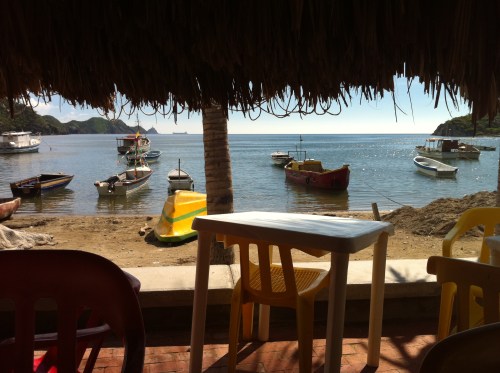
Looking out over the bay in Taganga while waiting for my freshly caught Red Snapper to be served.

Another interesting side note – much of this little town’s wealth came from ‘seed money’ in the 70s as a result of the lucrative illicit marijuana trade to the US. Local traquetos laundered the money by investing in real estate, agro-industry, and boosting the local tourism industry. The U.S. market has long since moved to closer producers (British Columbia, Mexico, California) to meet domestic demand and Taganga appears to rely mostly on tourism as its lifeblood. Cheers.

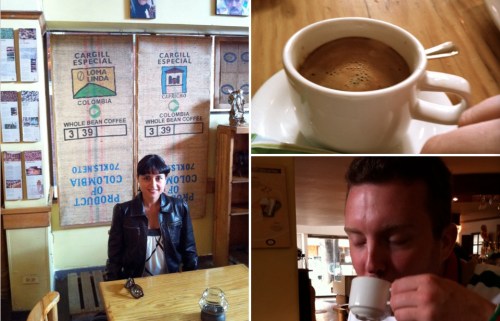
Cafe Hounding: Cafe Don Pedro – Bogota, Colombia

Carrera 11A # 89-48
Bogota – Colombia
http://www.cafedonpedro.com/primera_del_Cafe.htm

Don Pedro's interior from the back room looking out towards the adjoined bakery run by Pedro's wife.

Cafe Don Pedro is one of those places that began Maher Hound’s entire journey into the coffee world.  An exercise in objectivity would be senseless in this post considering my first encounter with the wonderful Colombian grown stimulant known as Cafe Don Pedro began in the late nineties after my father received a pound as a gift from a friend stationed at the US Embassy in Bogota.  At the time my family did not find the coffee particularly amazing and I was too young to have taken up the habit of coffee drinking full-time yet.

Several years later, after being reintroduced to Colombian coffee through a chocolate covered experience with Oma coffee, I found my way down to Colombia and into the storied retail location of Cafe Don Pedro on Calle 90 where it intersects Carrera 11A.  Beyond having one of the most folkloric, traditional coffee themed interior designs I have ever seen in a coffee shop; Cafe Don Pedro had very well trained and highly knowledgeable staff that were able to describe everything about the entire supply chain process of a coffee plant/bean and how to prepare beverages with care and with style.

My first visit to Cafe Don Pedro in the flesh was in 2006.  This was before I had been properly introduced to cupping and understanding the careful and lengthy process of training one’s palate to distinguish subtle discrepancies in the flavor profile of different beans and brews.  Even at this early juncture of my coffee loving career, I knew I had come across a truly amazing quality of coffee.  Upon my departure from Colombia several months later I carried several pounds of the delicious substance with me (beans were packaged according to their Department (a national sub-unit similar to a State) of origin). The most well-rounded beans sold by Don Pedro were probably the Cudinamarca blend – taken from the region immediately surrounding Bogota.  The most unique and distinctly (although quite mild) beans were those from Huila, found south of Neiva heading towards the Colombia-Ecuador border on the 45 highway. The Huila beans – last time I tried them in 2008 – had a vanilla and nutty undertone in the finish that was preceded by bright orange acidity in the initial sip.

Upon my return to Colombia in 2008, I made another stop at Don Pedro and enjoyed the comfortable ambiance and coffee of the shop.  Did I mention that, because they roast coffee every day right in the front of the shop, there is an overwhelmingly pleasant aroma of fresh roasted coffee that greets each customer upon entering the shop?

In 2008 I sat down and discussed the business – both the beauty of owning one’s own specialty coffee retail location in a country dominated by the Juan Valdez and FEDERCAFE image AND the problems associated with trying to leverage the international recognition of the Juan Valdez label while trying to directly export one’s own brand to international markets.  It appears that Pedro de Narveaz is still wrapped up in a legal dispute with the National Coffee Growers Federation in Colombia and this will likely – due to the political clout and financial resources of the Federation – end badly for our beloved Don Pedro.

Despite these facts, his business does incredibly well just by selling to the  Bogota equivalent of Washington, D.C.’s ‘Embassy Row’ with high praise coming from the US Embassy in Bogota and his own product positioning in Bogota’s El Dorado International Airport for those hoping to grab a bag of Don Pedro before hopping on the plane. I returned yet again to Don Pedro in July 2010 to grab five pounds and sample a delicious espresso with my girlfriend.  As she enjoyed her cappuccino with ‘fluffy foam’ and delicious coffee cookie treats, I reminisced about the more than four years of coffee patronage at this wonderful location in downtown Bogota.  Now, with the store moving down the street into a smaller shop on Calle 89 with 11A, I am both saddened and excited about the future of the Cafe Don Pedro experience.  The new commerce brought to this neighborhood by the incoming Mall will definitely boost foot traffic in and around Cafe Don Pedro, but it will also dramatically alter the quiet and charming experience that this neighborhood offered the older Bogotano crowd looking for an elegant cafe to discuss Colombian culture, society, politics and – most importantly – coffee.


Gently kissing this cup of C-marca espresso blend goodnight on my last evening in Bogota in July 2010.

Cafe Hounding: Ozzie’s Coffee Bar – Old Forge, NY

3019 Main St.
Old Forge, New York

As many of those who relish in a fresh cup of specialty coffee stumble across this page in ‘google’ searches for the next best thing in their locale, I stumbled across Ozzie’s Coffee Bar in Old Forge, New York while on vacation with family.  Often when traveling, one must take what they can get when it comes to getting the daily brew of coffee.

During my recent visit to Old Forge, I expected that I would not find anything worthy of Cafe Hound mention given the remote location and *assumed* lack of access to high quality roasters.  My assumption proved wrong the moment I walked through the doors of Ozzie’s Coffee Bar.

Ozzie’s customer service was yet another perk of this pleasant coffee cabin nestled into the quaint Adirondack town of Old Forge, New York.

I entered in search of free Wifi so that my friend and I could get some work done in between kayaking on the beautiful lakes of the Adirondack Mountains – only to find that there was no wifi available in this quaint shop. Although I nearly darted out the door upon learning of the lack of wifi, I took the plunge and ordered a standard double espresso to test their bean and barista quality.

My first impression was less than optimum given the fact that they served me a watery espresso in a large to-go coffee cup… but… I cleared my mind and took in the aroma.  To my surprise the aroma was fresh, earthy with hints of chocolate.  Next, I sipped in some of the semi-frothy crema that found its way on top of this drink.  It was pretty decent – made with well roasted and well preserved (i.e. relatively fresh) beans.  My only gripe is that the drink was too watered down because the barista intentionally over-pulled the shot (correctly assuming that the average consumer wants more liquid rather than more taste).

My friend ordered a chai latte (hot) and was also very pleasantly surprised.  I tasted her drink and found that it was made with high quality ingredients and was well prepared.  What a pleasant surprise.

The following day I returned to order another espresso (this time made with less than half the previous amount of water) and my friend ordered a skim cappuccino.  Both drinks were superb and thus I had to ask the baristas where the beans were from. I also asked for the owners information since I didn’t see her in the shop.

Albeit not that surprisingly, the beans used at Ozzie’s are not locally roasted.  Instead, the owner, Kristy Sutherland, prefers to create her own custom blend through a wholesale purchasing partnership with Aroma Coffee Roast in Larchmont, New York. Aroma is a known entity in the world of specialty roasters and continues to use a 12 KG roaster in order to achieve the careful control of each batch roasted on a daily basis.

In addition to splendid coffee, Ozzie’s also locally sources a variety of tasty treats, panini, sandwiches, salads and baked goods on a daily basis.  Cafe Hound promotes both an excursion to the beautiful Adirondack Mountains of upstate New York and a stop by Ozzie’s Coffee Bar along the way. We guarantee that there you will find plenty of hidden gems and scenic views along the way.

Markets: DC Coffee Scene

In 2006 I returned to the DC/VA area from Colombia with a newfound passion for specialty coffee and a serious cafe-dweller pattern of living  only to be extremely disappointed with what the DC/MD/VA area had to offer.  I said to myself, it is a no brainer that this region of the country has a tremendous of per capita spending power and that people here would pounce on the opportunity to have something unique in the food and beverage industry.  I thought the region was especially well suited for specialty coffee.

Although such an observation was so clear to me at the time, I had no knowledge of the specialty coffee industry beyond what I had discovered in Colombia over the course of a couple of weeks visiting farms and talking with producers.  I was in no way suited to open a coffee shop nor interested in doing so.

So – when this post began as a draft in August 2009 –  reminiscing as I drove through DC I could see my observation was not lost on others in the coffee retail industry.  Caribou Coffee shops are located in new places throughout the city, Peregrine Espresso launched in 2008, Chinatown Coffee Co. opened in July 2009, Mid-City Caffe, Big Bear Cafe and more all claim DC as their home now.

The growth in coffee shop improvement has not been lacking.  Names such as Murky, Peregrine, Big Bear, Tryst and others have made sure of that.  Caribou’s growth has been impressive too. Even a fellow in Manassas Virginia started his own line of retail coffee called Hondo Coffee.  The coffee is sourced only from one community in Honduras and is sold pre-ground in flimsy packaging that is its only protection from the heat and humidity of DC/VA summers – as he pushes the majority of his sales at local farmer’s markets.

August 2010 – So what is lacking from the DC market?

As far as I can tell it appears to have a serious shortage of local high quality roasters. The best coffee in the DC/VA/MD area is roasted elsewhere.

I would understand if one couldn’t find a good roaster in DC proper given the high rents for real estate and the potential difficulties getting a permit for the exhaust that comes from an industrial roaster but, this does not explain why the artisan roasters I have come across thus far in Maryland and Virginia have failed to meet the mark of quality, consistency and marketability that is required to survive and prosper in the specialty coffee industry.

Counter Culture cleans up in the Mid-Atlantic region (in terms of selling to high-end specialty coffee shops) and Intelligentsia has successfully convinced the high-end restaurant industry (i.e. Farmers & Fishers) to offer patrons a quality cup of java at a place where everything else on the menu is exquisite.  For now, Counter Culture has a relative stronghold on the region because people seem to believe that North Carolina is local enough AND they have a strong network of local-ish cuppings and trainings to attract local coffee shops/geeks into their network and identify them with their brand.

This business strategy is quite interesting and it will be exciting to watch the DC/VA/MD roaster market adapt to this pent up demand over the course of the next months. Until then, I’m open to any suggestions of DC/MD/VA roasters willing to part with samples for review by Cafe Hound.

Ano Novo Blend & Universal Education

Ano Novo Blend: Give the Gift that Keeps on Giving

The first custom Cafe Hound blend of 2010 is already receiving raving reviews from its first consumers!  As we continue to sell out our limited stock we are closely approaching our goal of having enough money to send a charitable donation to the Barefoot Foundation (Pies Descalzos) down in Colombia.  Below are some success stories from the English version of their website.

All content from the Barefoot Foundation website is the property of the Barefoot Foundation.

Source: http://www.barefootfoundation.com/index_en.php

Success Stories

The stories from the communities we serve inspire us to continue working for those who need us most. These comments from our students and their families describe the changes in their communities. For each success story, there are thousands more children who we hope to serve soon.

Ferley’s Story

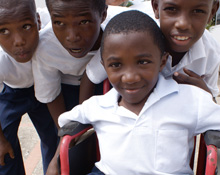
Ferley didn’t think he’d ever get to go to school. His thin frame is shrunken by congenital rickets, making him look closer to six than to his eleven years. His mother Clarisa said, “I was afraid that if I let him go to school, the other kids would call him names and make fun of him, and that he would be a burden on the teachers.” Clarisa Rentería and her five children are refugees who fled the violence of Colombia’s civil conflict, eventually settling in Quibdó, a western Colombian city. She explains, “I arrived here in 1999. It was heartbreaking to lose it all and be left with nothing.” The family struggled to survive and could not afford a wheelchair for Ferley. Without a wheelchair, Ferley could not get around the rocky streets.

However, Ferley didn’t want to stay confined to the house. He begged to go to school and longingly studied his siblings’ homework. Pies Descalzos visited Ferley’s house and talked to his mother, convincing her that her son would be well taken care of. When Clarisa saw the desire and determination in her son’s eyes, she agreed. Pies Descalzos bought Ferley a wheelchair and he enrolled in the Pies Descalzos School.

Four years later, Ferley is a happy, popular student who always has a smile on his face. He and his best friend Bryan are inseparable and they dream of continuing their studies. “I like to go to school because I learn a lot and because I like to share with my friends.” Ferley loves math, social science, reading and dreams of becoming a professional singer of Vallenato, a Colombian folk music style.


Ferley with Shakira

To teacher Absalón Asprilla Gómez, Ferley is a special student. “When I face something difficult, I don’t complain, instead, I think about his situation. He is one of the best students in the school, with a permanent smile, despite it all. For me, this is very meaningful. It has helped me grow a lot as a person.”

Pies Descalzos hasn’t just changed Ferley’s life; it has changed his whole family. Clarisa earns extra money for her family by preparing breakfast and lunch for the Pies Descalzos Foundation school as part of the “If I eat better, I will learn more” program. “We prepare lunch for the students and we help with the breakfast, so that they have food and they can study with full stomachs,” says Clarisa proudly. The meals they prepare are supervised by a nutritionist and made possible through Pies Descalzos and the Instituto Colombian Bienestar Familiar. This program helps make sure that the malnutrition that affected Ferley doesn’t affect other children.

The Barefoot Foundation helps hundreds of families like Clarisa and Ferley’s. The Pies Descalzos schools are open to everyone and serve as a center for community development. Parents, neighbors and grandparents learn sewing, artisan skills and literacy while teens engage in micro-businesses, sports leagues, and leadership development activities. This neighborhood is changing and growing thanks to the community, and the Barefoot Foundation and the Pies Descalzos Foundation.

The Story of El Minuto de Dios School, Altos de Cazucá

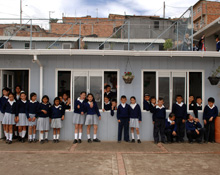
Elementary school teacher Consuelo Pachón barely recognizes her school, El Minuto de Dios, anymore. She teaches in Soacha an area south of Bogotá that was once a booming mining town. Today, its hills have been stripped of their natural resources, the mines left behind environmental damage and the jobs disappeared. The vacuum left by the mines has been filled with desperately poor people and internal refugees from Colombia’s civil conflict. Thousands flood in each year with nothing but their lives. Fifty-three percent are younger than 14 years old and many children have missed years of school while fleeing.

Before Pies Descalzos Foundation, El Minuto de Dios was in shambles. “At the start it was very hard. The school room walls were made of spare wood, the same kind they use to make fruit crates. The stairs were carved out of mud and, whenever it rained, the children slipped and fell. There weren’t bathrooms, just a latrine. “But now, the conditions have changed tremendously” she commented, raising her eyes to the ceiling in thanks.

The Pies Descalzos Foundation rebuilt the school; they installed sturdy buildings, libraries, computer rooms and safe bathrooms. Pies Descalzos, in alliance with the International Organization for Migration (IOM), the government, and Secretary of Education of Soacha, the Minuto de Dios University and the Educational Alliance, support two schools in Altos de Cazucá. In each, they provide nutritious meals, extra programs for troubled kids, recreational and leadership programs, while supporting parent cooperative that help families leave poverty. The community and the children have a safe, supported place to develop. As Ana, one of the school’s parents said “they now have the possibility to imagine a tomorrow filled with human and professional possibilities in this society.”

Jhonathan’s story

Jhonathan wants to clean up Altos de Cazucá. The 17 year old environmental biology major at Jorge Tadeo Lozano University knows only too well the pollution that plagues this poor area south of Bogotá. He moved to Altos de Cazucá as a baby with his mother and siblings. The family struggled to eke out a living, but his mother wanted more for her children so she enrolled them in the Gabriel Garcia Marquez Institute, one of the Pies Descalzos schools.

“The Foundation radically changed my life,” says Jhonathan.  “It taught me to relate to other people and that material things aren’t the only things that count. It helped me realize what my life’s project should be.”  With Pies Descalzos’ support, Jhonathan scored among the highest students in the country on the high school exit exams. He and other top Pies Descalzos students received university scholarships from Pies Descalzos to pursue their dreams.

“The University is an enormous responsibility, not only for myself and my family, but to help the rest of my community,” says Jhonathan. He and another student, Maicol, are using their education to create a recycling business that will provide much needed jobs and help clean up the local environment. Jhonathan also returns to his old neighborhood to tutor kids in school and help them imagine their true potential. “We use games to make learning fun and to expand their interest in school” says Jhonathan.

He loves learning and is eager to continue studying. He would like to pursue a master’s degree in systems engineering and learn French and Portuguese. But, no matter how far he goes, he will never forget the Pies Descalzos Foundation, the Barefoot Foundation and the lessons they taught him about service and believing in his own potential.

Give the Gift that Keeps on Giving and contact Cafe Hound today at maher@cafehound.com or krislert@cafehound.com OR give directly to the Barefoot Foundation by following this link.  Thank you for your time and for relationship with Cafe Hound.  Happy 2010!