Author Archives: Cafe Hound

Market News: Crop Fears Drive Kenyan Coffee Prices

Source: Agrimoney.com

The coffee industry has been experiencing incredible upward pressures on ‘C Grade’ prices over the past year.  The specialty coffee market is facing even more acute pressures as demand surges and supply is scarce.  Nairobi’s Coffee Exchange illustrates the scenario playing out in specialty coffee hotspots globally with the recent sale of one 340kg lot of premium AA for $1,011 per 50kg bag (approximately US$9.20/lb) in country! Applying standard export mark-up premiums to such a large purchase, assuming a US specialty coffee buyer was interested, could fetch anywhere between $30-60 a pound for this same coffee by the time it retailed in the United States.

Agrimoney Article Begins:

Could coffee become more valuable than your average base metal?

It is beginning to look that way – at least for top quality arabica beans in Kenya, where dry weather has dashed hopes of a production rise this season.

A lot of premium AA grade coffee sold at the Nairobi Coffee Exchange on Tuesday for $1,011 per 50kg bag, 40% higher than it was achieving last month.

The 340kg lot originated from a central Kenyan growers co-operative, Kiomothai, and was bought by East African specialist C Dormans, which sells to foreign markets besides running a chain of Kenyan coffee shops.

Dornams paid the equivalent of more than $20,000 tonne, making the coffee more than twice as expensive as copper, and approaching the levels that the likes of aluminium, nickel and tin trade at.

‘Outlook robust’

The price reflected the dearth of high quality beans for sale, Daniel Mbithi, a Nairobi Coffee Exchange official, said.

“There is no coffee and the market is grabbing the few available offers,” he told Reuters, the news agency, adding that “the price outlook remains robust going into the coming weeks”.

“Supplies remain tight.”

Production downgrade

Kenya, unlike some other African countries, has suffered poor coffee growing weather with unusually late and heavy rains early in 2010 damaging flowering before dry conditions later in the year damaging yields of fruit which did set.

The Kenya Coffee Board on Monday cut to 40,000 tonnes its forecast for the country’s coffee output in 2010-11, from a previous forecast of 49,000-55,000 tonnes, and leaving the crop on track to fall short of the previous season’s output of 45,000 tonnes.

The influential International Coffee Organisation last week lifted its estimate for world coffee production this season citing better weather in many major African producing nations, with the likes of Ethiopia, Tanzania and Uganda enjoying improved conditions.

In New York, arabica futures for March delivery stood 1.0% higher at 234.60 cents a pound, equivalent to $5,172 a tonne, at 11:45 GMT


Cafe Hounding: Cafe Samba – Bogota, Colombia

Cafe Samba
Bogotá, Colombia
Cra 7 # 58-48
Tel: 348 1697

Unfortunately, I enjoyed Café Samba so much that I’ve barely even took a photograph of the place, though having frequented it on many occasions spanning from 2006 to 2010.

It is difficult to state what the best part of the lounge/cafe/bar located on the Septima is: the coffee products, natural juices, and cocktails are simply the best in that part of Bogotá; the moderately sized food selection is equally impressive in quality. They make the most of what they have when it comes to ambiance of the place (lounge feel even without the chic lounge budget of the Chico and Parque 93 neighborhoods). Service is superior for the price range and the couch located at the front of the shop always seemed to be reserved for me. Also, the clientele is an attractive youngish blend of professionals and students.

My favorite item on their menu would be a fresh blended non-alcoholic natural joice cocktail of Maracuya, Mango and Orange Juice mix. The quality of their coffee is above average for a country that exports the majority of their high quality beans.  They use a high quality vintage Elektra espresso machine and decent coffee roasted in country.  I imagine they could improve their coffee quality if they sourced their coffee from a better roaster.

Musically, this café makes an impression on locals and visitors alike considering the high quality sound system wired from wall-to-wall and mounted in the ceiling. The “DJ” tends to be whatever barman  has a free moment. Luckily, all have terrific taste when it comes to selecting a good playlist.

View of Bogota afternoon from front of Cafe Samba

If you make it to Colombia, Cafe Samba is well worth a stop along the way.

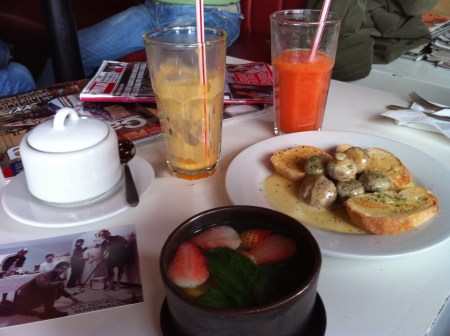
Mushrooms, Aromatica Tea, Fruit Drinks in 2010

– Maher Hound

Cafe Hounding: Cafe Grumpy – New York, NY (Chelsea)

Cafe Grumpy (Chelsea) West 20th
224 West 20th Street
New York, NY 10011
Phone: 212 255 5511
http://www.cafegrumpy.com/locations/cafe-grumpy-chelsea/

Best coffee in New York; possibly the entire Atlantic Seaboard.

They began roasting their own beans in September 2009 (at Greenpoint roastery in BK, New York). Before that, that only bought wholesale from the best roasters in the United States (including Novo Coffee, Intelligentsia, Ritual Roasters, Blue Bottle, Counter Culture).  Both Kris and Maher visited Cafe Grumpy in October 2009, their initial visit to this location.  The clean and bright interior of the locale is very appealing and it becomes immediately apparent that Grumpy is very serious about coffee and about great customer service.  The baristas all are very well trained and coffee knowledgeable.  The machines are all of excellent caliber and the cleanliness is very impressive.

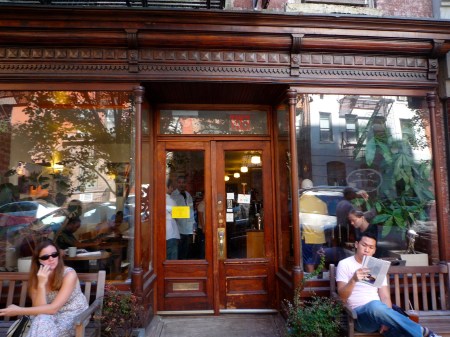
Cafe Grumpy (Chelsea) from the front.

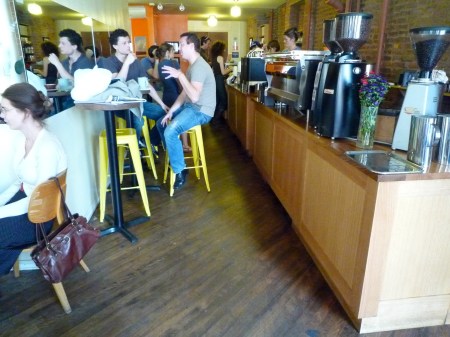
Cafe Grumpy (Chelsea) from the entrance. Old friends catching up inside.

There is no wi-fi here and the philosophy of the management is that people come to Grumpy to socialize, drink coffee, and NOT get lost in their electronic equipment.  Given the popularity of iPads and smartphones these days, I’m not entirely sure that the management is completely batting back the gadget-aholics.  That said, the quantity and volume of conversations here is noticeably more than in many other shops visited in DC and elsewhere.  Without a much surprise, during this October trip Kris and Maher visited at least five shops – including Abraço, Everyman Espresso, Mud (East Village), Juan Valdez – and Grumpy easily bested the rest.

Cafe Grumpy cappuccino with latte art included 🙂

Coffee here was plentifully available in retail whole bean variety and drinks were made carefully and wonderfully.  UPDATE:  In November 2010 a friend recently brought me a pound of ‘Heartbreaker’ from New York.  This is the first time that I’ve had the opportunity to try their self-roasted blend (formerly custom blended by outsourced roasters).  It rocks as espresso.  Not bad for drip coffee but wouldn’t recommend it.

Blue Bottle has recently opened its own location in New York and now Grumpy is roasting its own beans.  As the top of the specialty coffee segment broadens its customer base, competition among the best is increasing.  Following the increase in market size and competition among the major players, there has been a very interesting diversity of business strategies employed by the big names. More to come on this…

– Maher Hound

A Green Pod? Trade-off between Convenience and Environment

This is an interesting article from the New York Times on the problem faced by coffee industry– how to make gourmet coffee preparation convenient to customer while preserving the environment.

A Coffee Conundrum
By MURRAY CARPENTER

WATERBURY, Vt. — Green Mountain Coffee Roasters has built a reputation as an eco-friendly company since it was founded nearly 30 years ago.

It started composting used coffee grounds in 1983, helped develop an eco-friendly paper cup in 2006 and last year installed a huge solar array on the roof of its distribution center. The company’s motto, “Brewing a Better World,” reflects its belief that it has a responsibility to help improve living conditions in regions that grow coffee beans.

But its recent growth has been fueled by a product that runs counter to its reputation. More than 80 percent of Green Mountain’s $803 million in sales last year came from nonrecyclable, nonbiodegradable, single-use coffee pods and their brewing systems. This year, the company expects to sell nearly three billion K-Cups, the plastic and tinfoil pods that are made to be thrown away — filter, grounds and all — after one use.

Now Green Mountain and its rivals are beginning to wrestle with the waste issue and searching for ways to make the packaging greener. Possible solutions include more use of biodegradable packaging, programs to recycle the pods or making the coffee filters themselves reusable.

“The whole concept of the product is a little bit counter to environmental progress,” said Darby Hoover, a senior resource specialist for the Natural Resources Defense Council. “If you are trying to create something that is single use, disposable, and relies on a one-way packaging that can’t be recycled, there are inherent problems with that.”

In the battle for market share, single-serve systems are helping coffee remain competitive, Judith Ganes-Chase, a consultant to the coffee industry, said. “The industry has to be innovative. There is a lot of competition from other beverages in the marketplace,” Ms. Ganes-Chase said. “One of the biggest issues has always been the convenience factor of how to get a good cup of coffee to the consumer at any point in the day, when it is demanded.”

Ric Rhinehart, executive director of the Specialty Coffee Association of America, said that although single-serve sales were growing rapidly, they still amounted to a small percentage of the more than 100 billion cups of coffee Americans drink every year.

Green Mountain’s K-Cups come in 300 varieties of coffee, tea and hot chocolate, and a new line of blends made to be brewed over ice. The cost varies, but is often about 60 cents a cup, or $25 a pound of coffee.

At the plant, in a mountain valley between Burlington and Montpelier, burlap sacks of green coffee beans from all over the world are stacked on tall pallet loads in one warehouse. Next door, the beans are roasted. Most are then ground and packed into K-Cups.

The containers resemble oversize creamer tubs. On machines here, they are lined with paper filters, filled with coffee, topped off with nitrogen gas to prevent oxidization, and sealed with foil. The cups work with brewing machines designed by Keurig, a Reading, Mass., subsidiary of Green Mountain.

In the machine, pins puncture the foil top and plastic bottom of the K-Cup, and hot water flows through, brewing a drink into a mug. Then the little cup gets tossed.

Michael Dupee, Green Mountain’s vice president for corporate social responsibility, said some customers did not like to see the waste. “Consumers see the waste stream,” Mr. Dupee said, “and they compare it to what they had done before, and they have a perception that there is a problem.”

To some consumers, however, the convenience and efficiency override the waste issue.

“We used to make a pot of coffee, and we would be throwing it out all the time,” said Michael Hurley, who uses the K-Cup system for concessions at small-town movie theaters he owns in Belfast and Houlton, Me. “So we don’t do that anymore. And when people come in, they get exactly what they want.”

Mr. Dupee showed off a prototype that Green Mountain planned to test this summer. It is a paper K-Cup, filled with Celestial Seasonings tea, that eliminates the plastic and the aluminum foil. In addition, he said many consumers had started brewing coffee in reusable metal-mesh filters for the Keurig machines, which accept ground coffee.

Green Mountain, he said, has also commissioned a life-cycle analysis to understand the environmental costs of the K-Cups. Though he would not discuss details of the analysis, pending a third-party review, he did say the study found that most of the impacts occur where the packaging is produced, not where the waste is disposed. He said he had been working with suppliers to make their manufacturing processes cleaner and more efficient.

He also cited Green Mountain’s collaboration with International Paper to develop the Ecotainer — a hot-beverage cup with a plant-based, compostable lining — as an example of progress in packaging.

Other coffee companies are also wrestling with the waste issue. Businesses that use Flavia pods, which is made by Mars, are able to ship the used pods to the New Jersey company TerraCycle, which will compost the coffee or tea and reuse the plastic in products like pavers and fencing, a TerraCycle spokesman, Albe Zakes said. More than 2.5 million Flavia packs in the United States have been recycled in the last year. Mars sells a billion drinks a year in 35,000 workplaces worldwide.

In Britain, Mr. Zakes said, TerraCycle has processed more than 800,000 coffee discs from Kraft’s Tassimo single-serve system. The results are being evaluated for possible application in the United States, a Kraft spokeswoman, Bridget MacConnell, said. Kraft and Mars are paying for collecting the pods, including shipping costs to TerraCycle.

Sara Lee has a simpler solution for its Senseo pods — the coffee-filled filter bags are made of paper and are biodegradable and compostable.

Nestlé’s upscale Nespresso system uses aluminum capsules, and it has started a pilot program to collect used pods for recycling at some Nespresso Boutiques.

Ms. Hoover, of the Natural Resources Defense Council, said another option was to include prepaid mailers with coffee pods, as Hewlett-Packard has done for ink-jet cartridges.

Green Mountain’s chief executive, Lawrence J. Blanford, said the K-Cups had some environmental benefits. Brewing one cup at a time means less wasted coffee at the bottom of the pot, and this reduces the overall environmental impact per cup of coffee.

K-Cups are also increasing demand for fair-trade coffees, he said, which accounted for 30 percent of Green Mountain sales in 2009. Fair-trade-certified coffees ensure that coffee farmers are paid a fair price per pound, and that coffee farms meet certain environmental standards.

Peter Meehan, chief executive of Newman’s Own Organics, said the success of the K-Cups, which are his company’s fastest-growing product, had helped Newman expand the market for organic products.

Still, Ms. Hoover wonders whether there is a simpler solution to the waste question. “At some point you have to ask, ‘But do we need this product enough that we need to be trying to find all these different solutions for the components of it, or can we just go back to the old way that we used to make coffee, and was that good enough?’ ”

http://www.nytimes.com/2010/08/04/business/energy-environment/04coffee.html?_r=1&pagewanted=printhttp://www.nytimes.com/2010/08/04/business/energy-environment/04coffee.html?_r=1&pagewanted=print


Order Now!!! Ano Novo 2010 Blend by Kris/Maher

For information and order, contact maher@cafehound.com or krislert@cafehound.com

In tribute to the new year, Cafe Hound presents to you the ANO NOVO 2010 Blend. Ano Novo means New Year in Portuguese and reflects our appreciation to Novo Coffee in Denver, Colorado, who perfectly roasted the beans for us. Concocted by Matthew Maher and Krislert Samphantharak, the blend mixes the best seasonal fair-trade and organic coffees of South America and Africa to provide a sophisticated, bright, and balanced flavor profile good for drip, press, or espresso brewing. The blend will give you a perfect beginning of 2010. All net proceeds will go to charity.

Specific coffees found in our blend include:

– Amaro Gayo Sun-Dried: Amaro, Ethiopia – Full body with a grassy overtone and nuances of strawberry, apple, chocolate and unripe banana.

San Rafael: Concordia, Colombia – This coffee has a strong acidity (tangerine nuances) followed by smooth finishing woody nuances. Very bright.  The coffee comes from the San Rafael estate of the Concordia municipality in the Department of Antioquia in Colombia. Maher has personally visited a number of coffee farms in this region of Colombia.

– Kenya Gatina: Nyeri, Kenya – A woody well balanced coffee with blueberry undertones that compliment the brighter elements of the previously mentioned coffees.  This coffee is quite different than the Ndaironi region releases that were on the market in mid-2009 and is far too berriful as a single-origin.

– Ojo de Agua: Volcan, Panama – Very balanced  mild citrus nuance with very silky finish.  Mixture of peanut and chocolaty nuances in the aftertaste.  At first appears uninteresting next to the sun-dried but in the end wins out on its “drinkability” and balanced finish. Novo has shared some additional details on the Ojo de Agua coffee from the Finca Hartmann in Panama.

“Some of the hardest-working and most environmentally committed coffee producers in the world, the three generations currently represented at Finca Hartmann all have a hand in daily operations. Much of the family’s land is primary forest and rests contiguous with the enormous Parque Nacional La Amistad, Central America’s largest national park. Despite uncountable offers to cut the forest for large monetary gain over decades, the Hartmanns remain committed to a future of coffee in balance with nature. The Hartmanns have a cupping lab on site and are leaders in coffee production for quality. Their expertise has been enjoyed beyond their own farm as they act as consultants for many Panamanian and other Latin American coffee producers.”

For ordering information please contact maher@cafehound.com . We encourage you to donate $10 for each half pound of coffee that you order (before shipping if you want it shipped).  As we manage the legal obstacles for setting up money transfers to our foundation partners in Colombia, Guatemala, Brazil, Nicaragua, Thailand, Indonesia and Vietnam – we will be giving all profit from the ANO NOVO 2010 Blend to a local food bank in Arlington, Virginia.  We will only have a limited amount of this very special blend so please place your order now, before it is too late!

Regards,

– The Hounds

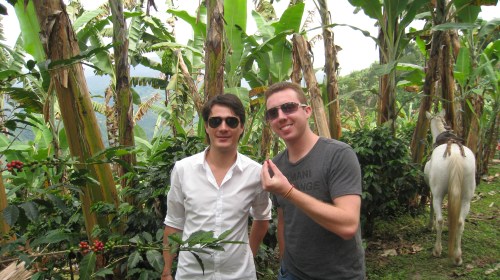
Coffee entrepreneur and Maher Hound at farmer Horacio Montoya's farm Alto del Naranjo in Caldas, Colombia (2008).