
An introductory preview of the sustainable movement, beginning with the organic movement and discussing the needs for global consciousness. This website, cafehound.com will evaluate the theory and methodologies of some of the people that speak in this video with the goal of contributing to the formulation of objective and credible sustainability standards for the agricultural industry worldwide. It all begins with coffee.
Beyond Coffee: Sustainable Coffee – A Global Solution (Video)
Posted in Beyond Coffee, Buzz
Tagged agrobusiness, Brazil, Cafehound, Coffee, coffee kids, Colombia, cosa, development, economic, environmental, farmers, guatemala, honduras, ico, indonesia, metrics, movement, Nicaragua, organic coffee, peru, rainforest alliance, SCAA, social, sustainability, sustainable, tanzania, vietnam, voluntary compliance
Official Release… “Cafe Hound”
Dear Readers,
Over the past six weeks, we have enjoyed unofficially blogging on cafehound.com and have seen the development of the blog and its traffic from visitors “accidentally” coming to our blog. It has been a pleasure to offer diverse information accessible on our blog. Today, we take another important step and officially introduce to you cafehound.com.
What you will find on our blog is random but hopefully informative. As the blog’s name suggests, we are Cafe Hound. We search for the best coffee the world can offer. In Cafe Hounding section, you can read our reviews of cafes from the Pacific to the Atlantic. Coming soon, we will add reviews of coffee houses outside the US. We are also proud to present to you the exclusive interviews of “Who Is Who” in specialty coffee industry. We are honored to have Chuck Patton (founder and owner of Bird Rock Cafe Roasters in La Jolla, California) as our inaugural feature in this interview section. To be added to the list of fame are Eileen Hassi (founder and owner of Ritual Coffee in San Francisco), Michael McGuire (owner and roaster of K-Bay Caffe in Homer, Alaska), Timothy Castle (founder and CEO of Castle & Company, Santa Monica, California), and Karen Cebreros (founder and CEO of Elan Organic, San Diego, California).
Cafe Hound is not only the place you can get reviews and knowledge about your neighborhood cafes. We carefully select and present to you interesting news and upcoming events in coffee industry. Moreover, with our expertise in economics, finance, international relations, and public policy, we devote a section of the blog to analytical and educational issues related to every stage of specialty coffee production– from crop to cup, or from beans to brew. Currently, we proudly review an interesting article by Christopher Bacon of the University of California, Santa Cruz, on how organic, Fair-Trade, eco-friendly coffee could potentially help poor farmers in developing economies get out of poverty. Our main objective is to present to you the cutting-edge academic research on coffee-related issues in a non-academic language. Stay tuned for more of these geeky but exciting posts.
You may want to ask yourself why we, as an academic economist and a policy expert, fell in love with coffee and decided to devote our time to this blog. We have explained it all in the About the Hounds section. For those who have known us before, this section will give you eye-opening stories of the “dark” (but creamy and aromatic) side of our lives. We hope it entertains you and answers your curiosity.
You may also want to know what we expect from this blog. Well, first and foremost, we view this blog as our way to get us exposed to more people in the coffee industry. This is not only those working in the industry itself, but also those who are frequent customers of coffee houses and share our passion in great coffee. Please come join us in our journey to search for the best coffee. Please suggest to us where we should go “cafe hounding.” If you have favorite neighborhood coffee houses, feel free to share with us.
Finally, we realize there are several blogs and discussion boards out there covering coffee and cafes. Many of them are fantastic and comprehensive. By no means do we view our blog as their competitor. Instead, we think that our blog will offer something different, and provide you with both casual and more formal, semi-academic knowledge. The Cafe Hounding section does not rate the cafes (like yelp or other restaurant rating websites) but rather presents you with objective reviews of coffee houses that we carefully select. Most of them are mentioned by local coffee geeks as the “best in town” cafes or employ baristas who have made it to the final round of national or international competitions. The Interviews section gives you behind-the-scene stories about people in your neighborhood cafes and others in the industry that you may not have known before. Finally, the coffee.edu section takes advantage of our strengths and expertise in our main professions as an academic economist and a policy expert. It is very educational in a strict academic sense, i.e. very nerdy, but hopefully is exciting for those readers who are interested in more than just the taste and aroma of coffee.
And with this introduction, we officially proudly present to you… cafehound.com.
–The Hounds
Tagged Alaska, analysis, blue mountain, broker, Cafe, cafe hound, Cafehound, Chuck Patton, Coffee, coffee industry, commodities, cosecha, crop to cup, espresso, Ethiopia Amaro Gayo, farmer, geisha, gourmet coffee, green coffee, harvest, henry hueck, Importer, karen cebreros, Kenya AA, Kona, Krislert, Maher, New York, Nick Cho, panama, review, roaster, San Diego, San Francisco, SCAA, specialty coffee, sustainable, tim castle, trader, Washington D.C.
Cafe Hounding: Mud Coffee – New York, NY
Mud Coffee – New York
307 East 9th Street #GRDN
New York, NY 10003
http://www.themudtruck.com/
Phone: 212.529.876
It was 9:30pm on a Saturday night in the East Village and all of the spots we had heard so much hype about were already closed — (i.e. Abraço and Ninth Street Espresso).
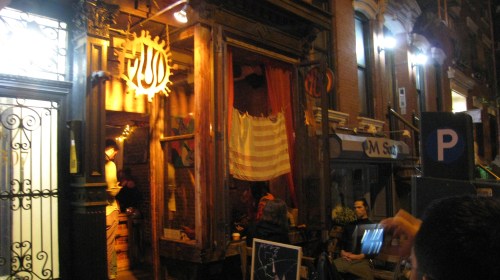
Mud Coffee on a Saturday night.
After a quick Yelp search we found ourselves at the steps of Mud Coffeehouse. Immediately upon arrival in this hipster neighborhood of the East Village we knew had found a special place with a very unique ambiance. The first thing to catch our eye was the nicely packaged Rainforest Alliance coffee sitting at the front counter of the store. One particular part of their motto that stuck out was “Take a Hit and Pass it On” — referring to their coffee, of course.
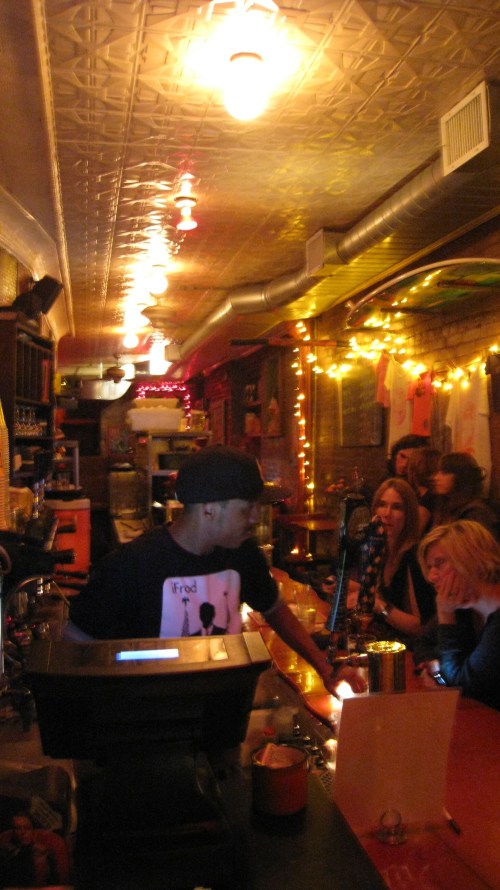
Heading Back...
The front has a nice window seat that is comfortable for two people to lounge around in with the plush pillows and street view. There is bar seating as you walk back into the restaurant. The lighting is dim and the decor is about as vintage hipster as you can get. The music selection matches the decor with reggae, Beatles and blues all finding their way onto the track list. The servers are very attentive and welcoming. In spite of their branding as a coffee place that is “anti-establishment”, their cappuccino wasn’t what really put this place on the map for us.
The garden room in the deep back of the establishment had ceiling fans, industrial/vintage decor and simple lighting. Furthermore, the crowd was young — probably partially NYU students — and attractive. Besides the fact that we encountered people tipping back beers at the bar, cramming out papers in the indoor lounge, and having wine & cheese in the ‘garden area’ reflects how effectively Mud has created a community within a community. The food menu seemed simple but elegant and the more common drink on a Saturday night around 10 was Cab Sav… not coffee.

Gateway from Garden to Bar
All in all, this is the type of place that is 100% worth stopping through. You may not find that they know everything there is to know about brewing and/or roasting coffee but, they know how to carve out a slice of genuine identity in a part of NY that often tries too hard to rage against the machine.
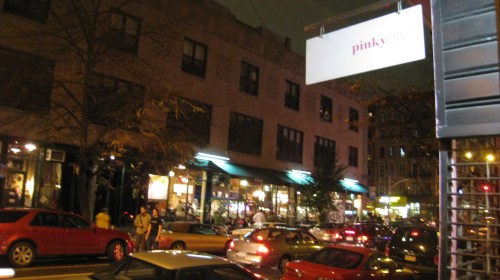
Looking Out from Entrance
Tagged Bar, Cafe, Coffee, Downtown, East Village, East Village Coffee, Hipster, Mud, Mud Coffee, New York, New York City, NYC, NYU, specialty coffee, Village, Wine & Cheese
Buzz: Otherside of the ’15th Avenue Coffee and Tea’ Coin
Just because I think both the detractors (read: haters) and the supporters of the newish Starbucks move to test the higher end specialty coffee waters have made some very salient points with regard to the changing dynamics of the specialty coffee industry.
- Starbucks MUST be respected for its sheer ability to throw money and professional marketing at any scheme that they arrange.
- The hipster coffee house vibe — that many of the places that are charging $20 a pound for fresh roasted coffee from reputable outfits like Blue Bottle, Ritual, Novo, Intelligentsia and Counter Culture — does not appear to be something that the Starbucks corporate people will ever be able to roll-out on a large scale.
- What it does appear Starbucks’ wants is to leverage its sheer advantage in liquidity (read: lots of $$$) and marketing to increase their share of a market that is a sub-sector of their core industry. As a major buyer of green coffee all over the world it seems logical that they would leverage the best of their strategic relationships to promote higher premiums, no? It makes perfect business sense and the following article gives a more balanced look at the non-hater side of the the 15th Avenue Coffee and Tea story.
Source: Tamp Tamp Blog

We finally made it to see the new 15th Avenue Coffee and Tea (”Inspired by Starbucks” as it says on the door) on Capitol Hill in Seattle. After all the specialty coffee hubbub, press, and dramaover what this means, and after reading the considerably dramatic yelp reviews, we had to see it for ourselves. It puts an interesting question out there – can Starbucks make a better Starbucks?
In New York, when we first heard about it, we were skeptical. When we think of Starbucks, we picture the lines of caffeine deprived junkies queued up by the dozen, packed into a place pumping out big milky drinks by the gallon, with rarely a smile on any face – customer or barista. Like most situations in New York, the stakes are higher, and the throngs battle it out to make it out with their drink. Does it taste like coffee? Perhaps, but what’s most important is that you made it out with something hot and you’re still alive.

This is the line at the original Starbucks retail location at Pike Place Market, downtown Seattle. This location used to be a fine purveyor of coffee beans only; now it looks a lot like an everyday Manhattan retail location (read: packed and stressful).
Starbucks’ reputation in New York is bad. And for people who’ve only known that big, corporate, bad-tasting, fast food retail-y experience, I don’t blame them. But as a Seattleite that grew up alongside the explosive growth of the company, I always speak positively of my very first experiences getting lattes at (where else?) Starbucks. And it was good. Our whole industry, and certainly my company, would be much less significant (even nonexistent) if Starbucks hadn’t tapped the consumer demand and opened the floodgates.
But still, there’s no denying that Starbucks lately has fallen on hard times. The coffee just hasn’t been that good, the shops are kind of dumpy, all Starbucks’ seem to have an unpleasant smell (what is the deal with that smell?). I hadn’t had coffee from Starbucks (with the exception of a Clover coffee last year) in several years. Why bother, when there are independent places, with great coffee, and great service (you can visit our tour if you need tips) right around the corners from many a Starbucks in NYC?
On the other hand, there are a lot of independent cafes that rest happily with the knowledge that they’re not Starbucks. But are they good? Well, no, not really. The coffee is ok, maybe some of the baristas are nice, and the atmosphere is decent. By and large, these cafes provide a sub-par experience. As consultants, we run into this mentality all the time, and are constantly checking that clients begin providing a much higher standard of service, and of course, most importantly, are providing the best possible product. There is simply no way that being “not Starbucks” is anything more than a lie owner/managers use to tell themselves they are doing a good job in their cafes. Most very high end cafes think of Starbucks as completely irrelevant – and while I think there are some great aspects of Starbucks (they’ve got independents trounced when it comes to retail and merchandising, for example, and it’s worth watching them for that), I generally tend to agree with the high end independents.
So when we walked into 15th Avenue Coffee on Capitol Hill, steps away from Victrola, we were keeping all of our standards as high as we do at any shop we visit. What’s the atmosphere like? Are we greeted right away? Are the chairs comfortable and are there multiple types of seating? Can we see this space being multi-functional, serving a lot of customers from various backgrounds? And of course, how is the product?


We were greeted cordially and were provided with some suggestions about what to try. I had a macchiato, and Neil got a Costa Rican coffee. We were served in porcelain cups. The latte art on my coffee was lovely. And most importantly, the coffee tasted pretty good. Maybe not the most unbelievable, delicious coffee in the world, but certainly pleasant and drinkable, and considerably better than many independent cafes in Seattle. I’m fairly certain that most coffee consumers wouldn’t see a discernible difference when picking between 15th Ave and Victrola in terms of cup quality. In New York, this shop could make a killing.

Does that mean that Victrola needs to look out? It’s doubtful. Victrola has a strong customer base and has been making great coffee for years. In fact, my theory is that Starbucks moved to that location to test the waters in a very tough location for them, just steps away from a high-end independent. In this spot Starbucks is definitely going to see if it’s possible for them to reclaim their glory as a high-end, products focused business. I think that for quality focused independents, this new incarnation will only increase awareness and bring in more customers, especially if they launch cafes in cafe-deprived areas.

What about other, smaller, less quality-focused cafes? Should they be concerned? Absolutely — if you’re using Starbucks as your measuring stick. Those cafes are in trouble anyway, they just haven’t seen someone come along to challenge them yet. But look out, everybody. Here comes a company that means business and wants to reclaim what it has lost.
coffee.edu: Alternative Coffee Markets and Poverty Reduction
Can Fair-Trade, eco-friendly coffee help farmers get out of poverty? One study suggests so.
Poverty and income fluctuation are the most important problems for many households in developing economies. Poverty is exacerbated when these poor households also face fluctuated income. For these poor households living in poverty and lack of access to financial markets, a slight drop in the price of their agricultural product forces them to reduce consumption and health expenditure, withdraw their children from school, or sell their productive assets. All of these responses to the adverse event lead to lower productivity in the long run, further reducing their chance to get out of poverty. This is especially the case for poor small-scale farmers, whose income is low and vulnerable to crop failures or drops in output prices. However, a study of coffee farmers in Northern Nicaragua by Christopher Bacon may provide a potential partial solution for poverty and vulnerability reduction for these households.
The study took advantage of the changing structure of the global coffee markets in the 1990s (the disintegration of the International Coffee Agreement, market liberalization, and higher rate of transnational corporate concentration). The events led to the decline in world coffee price since 1997 throughout 2005. (Specifically, the average price of mild Arabica beans grown outside Colombia dropped from almost 2 USD per pound in 1997 to slightly above 50 cent in 2001.) To make the situation worse for Nicaraguan farmers, the drop in world coffee price came at the same time as the 1999-2001 droughts.
Bacon conducted an interesting survey of 228 small-scale coffee farmers in Northern Nicaragua in 2001, right at the time when coffee price hit one of the lowest levels in years. He found that the average prices paid at the farm gate for the 2001-01 harvests differed tremendously by the markets. Coffee sold by cooperative members directly to roasters commanded the highest average price at 1.09 USD while cooperative Fair-Trade coffee and cooperative organic coffee were sold at 0.84 and 0.63 USD, respectively. In contrast, farmers selling coffee to local middleman earned only 0.37 USD. When Bacon looked at how long until the farmers got fully paid, he found that selling to local middleman took only 9 days while selling organic coffee through cooperatives took 73 days. The result is consistent to the fact that the farmers were forced to sell their product to local middlemen at large discount in order to get the payment quickly to satisfy their urgent need due to financial market imperfection.
According to 2000-01 harvest data, 80% of Nicaraguan coffee was potentially specialty coffee. However, only 10% of the 2000-01 harvests were indeed sold as specialty coffee. Bacon therefore concluded that specialty, and other nonconventional coffee markets (such as Fair Trade and eco-friendly coffee markets), which commanded higher price, would be a potential strategy that could help small-scale coffee farmers in Nicaragua achieve higher prices of their product and in the end mitigate their poverty and vulnerable to price shocks. What needed is the creation of the alternative nonconventional coffee markets for these farmers with potential for premium coffee trade.
Questions remain, however: What in fact explains the higher price in special coffee market and in other alternative coffee markets? Is it the inelastic consumer demand? Is it due to insurance or hedging mechanisms that provide the farmers a “buffer” to the change in world coffee price? Is it the bargaining power the farmers have as opposed to the exporter/importers? More research is needed before we fully understand whether and how nonconventional alternative coffee markets could help the poor coffee farmers. Surprisingly, the higher price is not one of the leading reasons the the surveyed households listed as their reasons for growing organic coffee, which include safety for their families and children without agrochemicals on the farm, lower expenditures for synthetic inputs, better environment, and protecting water. But promoting certified, organic, Fair-Trade, eco-friendly coffee to the poor farmers might be one of the strategies to which poverty-reduction campaigns might want to pay more attention, at least for now.
Posted in Beyond Coffee, Education
Tagged certified, Coffee, development strategy, eco-friendly, fair trade, farmers, Nicaragua, organic, poverty, vulnerability
 Cafe Hound