Cafe Hounding: Caffe / Illy – Washington, D.C.

Caffe: Marriott Renaissance M Street Hotel
1143 New Hampshire Ave NW
Washington, DC 20037
(202) 775-0800
http://www.yelp.com/map/illy-cafe-washington
http://www.marriottmodules.com/restaurant/hotels/hotel-information/travel/wasrw-renaissance-m-street-hotel/caffe_an_italian_coffee_house/

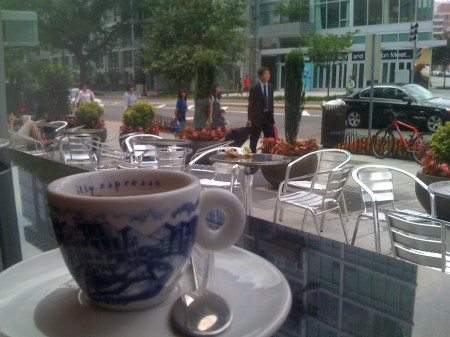
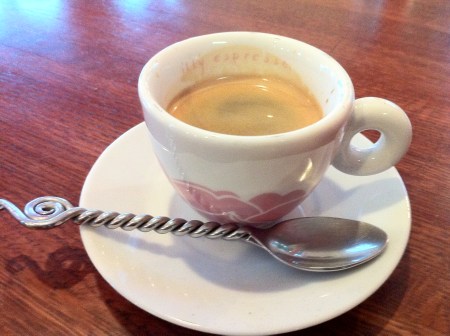
Caffe is the name of the coffee concept boutique coffee shop located within the Marriott Renaissance Hotel in the West End of NW Washington, D.C.  This was the first of several shops opened in the last three years that exclusively sell Illy coffee and their designer products (namely their fancy hand painted espresso cups/plates and pods). Although not my first choice for espresso in most cases, every time I’ve had a cup of Illy at this M Street location, I have been thoroughly pleased. The dark, complex and caramel-like finish of the typical Illy espresso is a proven winner.  The true to form syrupy crema that commonly accompanies a well made Italian espresso consistently shines through here and, based on third-hand accounts, their cappuccinos are also well-made.

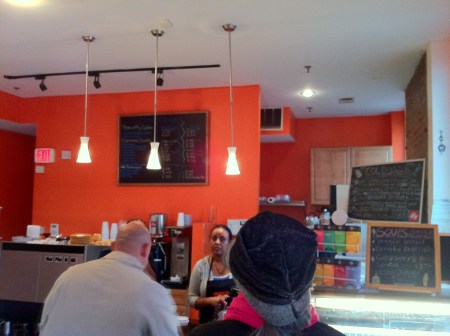
This is definitely not a place to sit down and work, eat a meal or chat for too long with friends.  Keeping in the typical Italian espresso bar tradition, there is only a standing counter along the windows of this petite shop where one is able to down their drink and continue on.  Not too linger friendly here.  Not to worry, just a quick walk through the into the adjoined restaurant (also part of the Marriott Renaissance Hotel) and you can begin an entirely separate dining experience.

In short, although this is not a place for much more than a quick coffee on the go – it is a quality coffee drinking experience and is worth a stop if you’re in the area and desire a quality made coffee drink.  The iced latte I had here in Summer 2010 was probably the best I’ve ever had.  Try getting a simlilar experience across the street at Starbucks — simply unheard of.

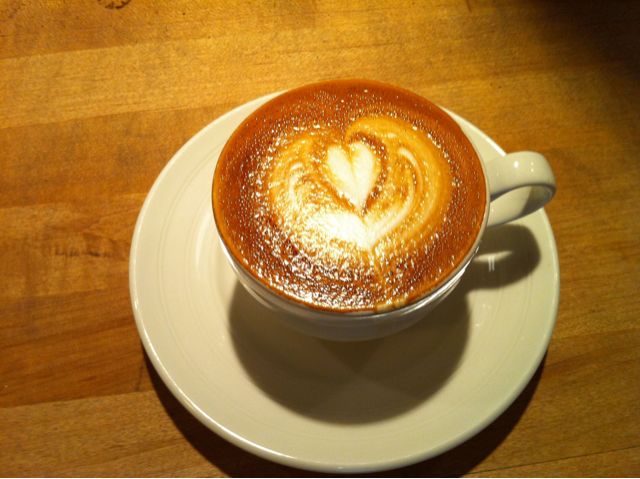
I like the cup (seen above) so much that I asked to purchase it.  I was pleased to find out that they happily sell the cup/plate/spoon sets used for a little under $10.

Here are some additional links that discuss the place:

WaPo
Yelp
Examiner
UrbanSpoon


Cafe Hounding: Azi’s Cafe – Washington, D.C.

1336 Ninth St. NW
Washington, D.C.
20001-4208
http://aziscafe.com/index.html

http://maps.google.com/maps/place?client=safari&rls=en&oe=UTF-8&um=1&ie=UTF-8&q=washington+dc+nw+1336+9+st&fb=1&gl=us&hnear=Washington+D.C.,+DC&cid=12196182154941226661

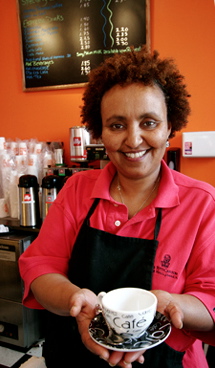
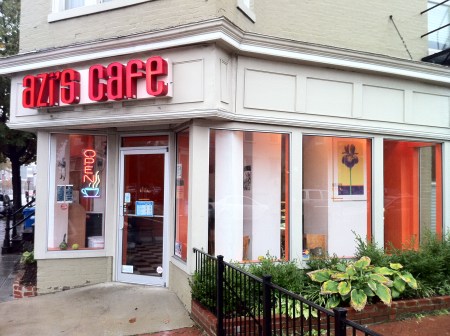
Azi’s Café is a wonderful place to grab a coffee and a meal in one of DC’s most diverse and dynamic neighborhoods – albeit not very commercial.  The charming owner, Azeb Desta (nicknamed Azi), hails from coffee’s disputed birthplace in the Horn of Africa.  Before opening Azi’s in 2005 she worked for eleven years in food and beverage with Ritz-Carlton hotels.

Her location at the corner of 9th and O streets is smack in the middle of a rapidly changing area of the Shaw area of DC, where an improving standard of living and an aversion to the normal “Starbucks” options appear to partially drive traffic to Azi’s Cafe. Perhaps more important, Azeb and her staff are some of the warmest and most dedicated employees in the business and their service clearly helps with customer loyalty. Furthermore, for the time being, there is very little direct competition in the immediate area.

The menu of light food fare boasts decent pastry, soup, salad and panini (the roasted turkey breast, tomato, cheddar, and garlic spread goes for $6.50) options.  Personally, I often find myself succumbing to the flavorful biscotti displayed in large glass containers in front of the cashier – it perfectly compliments a warm frothy cappuccino on a cold day.

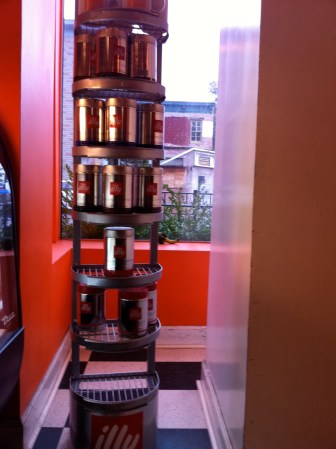
Generally, the coffee is above average for Washington and I’ve grown fond of their cappuccinos.  They use Illy coffee and have a stand of retail Illy for sale proudly exhibited in their front window.

Having sampled an Illy espresso across town at the Illy shop at the Renaissance M Street Hotel, I was excited to see how Azi’s compared.  The coffee itself was definitely up to par, bold and complex from start to finish.  The cup they used in my case was a designer Illy cup – of my choosing – that was plenty warm from sitting atop the French-made UNIC machine. The quantity of crema was less than sufficient, though, and I would have to wager the guess that the machine could be the problem. I’ll undoubtedly try another espresso here before making a final judgment on the quality of their coffee and ability to make drinks.  It also appears that they keep a pretty steady line of customers asking for both specialty drinks and regular cups of coffee during this time of year.

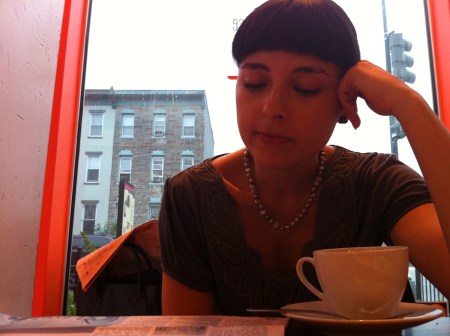
I’ve never visited this locale without a pleasant and eclectic mix of music weaving through the small locale.  The southern wall is littered with a few electric sockets for those who tote laptops and have a use for their free wi-fi. Others may choose between a few tables in the middle of the shop and a couple two-seater tables squeezed in between columns with plenty of natural light on the northside of the shop (sorry, no electric plugs on this side of the shop).

Whether for a hot bowl of soup, a freshly made salad, a steamy latte or a shot of espresso – Azi’s is quickly becoming an institution in the Shaw neighborhood and – with over five years of business in this locale – Azeb Desta seems satisfied that things are going in the right direction.  Although, she thinks that the last five years have gone by quickly, and that both the neighborhood and the clientele have changed equally quickly.  Azi’s Café is one of very few businesses thriving in this section of NW and it will be interesting to see how much/little she changes in the next five years in order to maintain a successful enterprise.

Café Hound will undoubtedly continue to frequent her shop and wishes her the best in growing her business.

Angolan Coffee: Cafe Ginga Lobito

AngoNabeiro / Cafe Delta / Cafe Ginga
Estrada do Cacuaco Km 5
PO Box 5727, Luanda
Email: anabeiro@snet.co.ao
Tel: +244 222 840161 / 62

How is the coffee?  How well is it delivered?

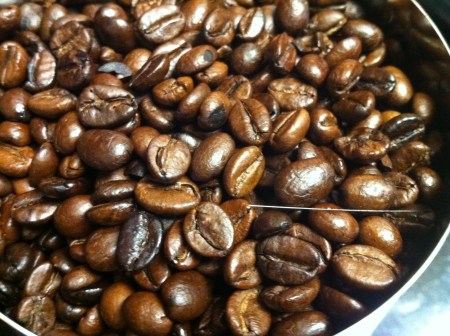
My expectations for any coffee that is roasted in a hot and muggy coffee producing country and transported to the United States in luggage are generally pretty low.  Opportunities for the coffee to be damaged by heat, humidity, and poor packaging are far too great. Upon receiving this kilogram of roasted whole bean coffee I politely thanked the gift bearer and placed any hope of this coffee stimulating my palate far from the reach of reality.  A couple of days later, I used my 480-watt Baratza Virtuoso burr grinder to grind up a fine espresso sample of the beans for use in a Gaggia Classic modified machine with a Rancho Silvia wand.  About 23 seconds later, a full Illy cup of syrupy espresso was ready to be slurped.  My initial surprise was that the machine pulled the shot surprisingly well for a first try.

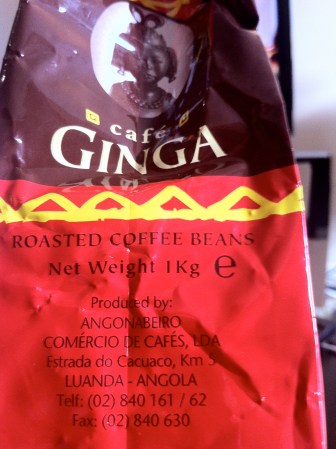
After sipping the shot I was surprised again with the freshness and fruitiness of the drink.  The aroma of the beans was not nearly as satisfying as the drink itself.  The quality of the beans themselves did leave a little to be desired.  The roast was not consistent enough to be considered specialty quality – with some beans barely brown and others burnt to a crisp. Also, some were very small and damaged while others were huge.  Furthermore, I found a piece of metal wire resting in between a few beans when I was pouring the bag into a storage container – reflecting less than ideal quality control standards by the processing company. The packaging for the beans is metalized with an additional layer of multicolored labeling and a valve application for allowing gases to escape after sealing – a high quality packing meant for beans that a company would expect to export and/or sell retail.

Again, the taste was exotic and I was encouraged enough to make an entire pot of drip coffee with the same beans.  The end result was a bit less to my specific liking – I like a brighter coffee with a lighter roast and more mild finish.  Although, on colder days I like a drip coffee with a bit more character in the body than my usual Central American and Colombian varieties.  I’ve begun mixing some beans from Cundinamarca, Colombia with my Angolan coffee that apparently originates on an estate (fazenda) called Lobito (not to be confused with the port city of the same name) and am pleased to drink this blend in both espresso and drip coffee form.

What’s in a name? Ginga’s backstory

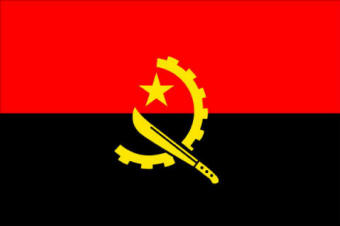
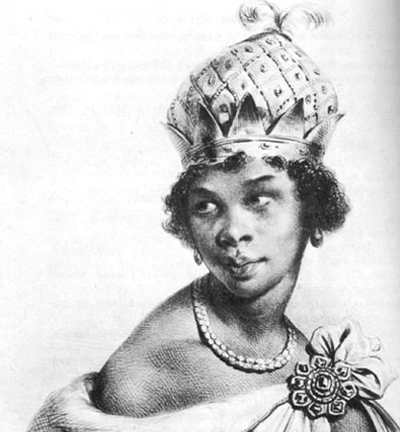
The Ginga (Njinga) name is distinctly Angolan, as it refers to a queen dating back to the times of the Ngondo Kingdom in Africa.  The Ngondo Kingdom was originally a tributary kingdom of the Kingdom of Congo – existing before the Portuguese colonizers arrived in 1482.  The Ngondo Kingdom was governed by Ginga’s father, Ngola Kiluange(Kiluanji), when the Portuguese arrived. He fiercely resisted the Portuguese as well as all other foreigners until his eventual decapitation. The Portuguese attributed the name Angola to the lands now known as Angola, not knowing/caring that the Ngola was the name of the ruler, not the lands.

Queen Ginga is a legendary figure in African history and the object of pride in Angola, as she is viewed as one of Angola’s most shrewd diplomats, rulers, military minds and intelligent leaders.  So much is written on her that her entire history appears to be in dispute and includes elements of near-mythology – certainly originating from the 16th century equivalent of smear campaigns and propaganda.  She is rumored to, at times, have adopted cannibalism, a very pious Catholic lifestyle, and – according to Maquis de Sade’s “Philosophy in the Bedroom” – she sacrificed elements of her all male harem of lovers immediately after lovemaking. In other words, there is much mystery and intrigue surrounding her life but she is most certainly a key historical figure in the Angolan national identity.

Throughout her political career, Queen Ginga both resisted and compromised with her Portuguese occupiers.  There seems to have been a relative interdependency between Ginga and Portugal.  She converted to Christianity, adopted tribal customs, and went to war with the crown and neighboring tribes – whatever ensured her survival.  Perhaps this is why the brand name Ginga is appropriate for a coffee company that claims to be 100% Angolan, yet is very much entangled in a past connected to Portugal. Ginga is one of two coffee brands connected to a holding company called AngoNabeiro, the other being Delta Café (a widely known Portuguese brand).  AngoNabeiro is part of a Portuguese conglomerate known as Nabeirogest, or more informally, Grupo Nabeiro.  One of the strongest performing companies in this group is Café Delta.  Café Delta dominates the coffee market in Portugal, is expanding rapidly in Angola and Brazil, and has long been active in segments of the East Asian market for roasted coffee (see Macau).

But, the Portuguese connection dates back to before Angolan Independence when AngoNabeiro was setting up coffee production operations in 1973 right before Portugal experienced a coup d’état in 1974 and, as part of a larger Portuguese agreement, Angola was liberated from colonization through the Alvor Agreement (Acordo do Alvor) in 1975.  Between 1975 and 2002, Angola endured a violent civil war that ravaged the countryside and made sustaining its agricultural economy very unpredictable. As in nearly all civil conflicts, land/property rights were constantly challenged creating terrible instability for coffee farm owners.

During the earlier part of the difficult times in Angola, Rui Patricio oversaw daily operations and ownership of AngoNabeiro inside of Angola.  Production continued, although at very small quantities, until 1983 when the company closed due to lacking technical assistance and know-how.  The physical infrastructure where AngoNabeiro’s main facility was located was loosely protected, unproductively, until 1998 when Delta Café proposed a revitalization of its coffee production in Angola.  By 2000, the Café Ginga brand emerged and by 2002 the civil war in Angola finally ended. Café Ginga and AngoNabeiro has grown steadily since, with an estimated US$1.2 million of annual revenues in 2005 according to Director General Rui Melo. Part of their growth has been thanks to a business structure where the mixed-capital Angolan company, AngoNabeiro benefits from Grupo Nabeiro’s know-how and financial largesse (capital and cash-on-hand). Café Delta is one of many companies housed within Grupo Nabeiro and it has been tremendously successful over the past decade.  As Ginga changes outside perceptions of high quality coffee within the Angolan market their ambitions are set on carving out market share in nearby South Africa and other countries in their immediate vicinity.

Rui Melo interview on history of AngoNabeiro (Portuguese): http://www.winne.com/dninterview.php?intervid=1686

Mr. Rui Melo
Manager / Director General of AngoNabeiro

A Green Pod? Trade-off between Convenience and Environment

This is an interesting article from the New York Times on the problem faced by coffee industry– how to make gourmet coffee preparation convenient to customer while preserving the environment.

A Coffee Conundrum
By MURRAY CARPENTER

WATERBURY, Vt. — Green Mountain Coffee Roasters has built a reputation as an eco-friendly company since it was founded nearly 30 years ago.

It started composting used coffee grounds in 1983, helped develop an eco-friendly paper cup in 2006 and last year installed a huge solar array on the roof of its distribution center. The company’s motto, “Brewing a Better World,” reflects its belief that it has a responsibility to help improve living conditions in regions that grow coffee beans.

But its recent growth has been fueled by a product that runs counter to its reputation. More than 80 percent of Green Mountain’s $803 million in sales last year came from nonrecyclable, nonbiodegradable, single-use coffee pods and their brewing systems. This year, the company expects to sell nearly three billion K-Cups, the plastic and tinfoil pods that are made to be thrown away — filter, grounds and all — after one use.

Now Green Mountain and its rivals are beginning to wrestle with the waste issue and searching for ways to make the packaging greener. Possible solutions include more use of biodegradable packaging, programs to recycle the pods or making the coffee filters themselves reusable.

“The whole concept of the product is a little bit counter to environmental progress,” said Darby Hoover, a senior resource specialist for the Natural Resources Defense Council. “If you are trying to create something that is single use, disposable, and relies on a one-way packaging that can’t be recycled, there are inherent problems with that.”

In the battle for market share, single-serve systems are helping coffee remain competitive, Judith Ganes-Chase, a consultant to the coffee industry, said. “The industry has to be innovative. There is a lot of competition from other beverages in the marketplace,” Ms. Ganes-Chase said. “One of the biggest issues has always been the convenience factor of how to get a good cup of coffee to the consumer at any point in the day, when it is demanded.”

Ric Rhinehart, executive director of the Specialty Coffee Association of America, said that although single-serve sales were growing rapidly, they still amounted to a small percentage of the more than 100 billion cups of coffee Americans drink every year.

Green Mountain’s K-Cups come in 300 varieties of coffee, tea and hot chocolate, and a new line of blends made to be brewed over ice. The cost varies, but is often about 60 cents a cup, or $25 a pound of coffee.

At the plant, in a mountain valley between Burlington and Montpelier, burlap sacks of green coffee beans from all over the world are stacked on tall pallet loads in one warehouse. Next door, the beans are roasted. Most are then ground and packed into K-Cups.

The containers resemble oversize creamer tubs. On machines here, they are lined with paper filters, filled with coffee, topped off with nitrogen gas to prevent oxidization, and sealed with foil. The cups work with brewing machines designed by Keurig, a Reading, Mass., subsidiary of Green Mountain.

In the machine, pins puncture the foil top and plastic bottom of the K-Cup, and hot water flows through, brewing a drink into a mug. Then the little cup gets tossed.

Michael Dupee, Green Mountain’s vice president for corporate social responsibility, said some customers did not like to see the waste. “Consumers see the waste stream,” Mr. Dupee said, “and they compare it to what they had done before, and they have a perception that there is a problem.”

To some consumers, however, the convenience and efficiency override the waste issue.

“We used to make a pot of coffee, and we would be throwing it out all the time,” said Michael Hurley, who uses the K-Cup system for concessions at small-town movie theaters he owns in Belfast and Houlton, Me. “So we don’t do that anymore. And when people come in, they get exactly what they want.”

Mr. Dupee showed off a prototype that Green Mountain planned to test this summer. It is a paper K-Cup, filled with Celestial Seasonings tea, that eliminates the plastic and the aluminum foil. In addition, he said many consumers had started brewing coffee in reusable metal-mesh filters for the Keurig machines, which accept ground coffee.

Green Mountain, he said, has also commissioned a life-cycle analysis to understand the environmental costs of the K-Cups. Though he would not discuss details of the analysis, pending a third-party review, he did say the study found that most of the impacts occur where the packaging is produced, not where the waste is disposed. He said he had been working with suppliers to make their manufacturing processes cleaner and more efficient.

He also cited Green Mountain’s collaboration with International Paper to develop the Ecotainer — a hot-beverage cup with a plant-based, compostable lining — as an example of progress in packaging.

Other coffee companies are also wrestling with the waste issue. Businesses that use Flavia pods, which is made by Mars, are able to ship the used pods to the New Jersey company TerraCycle, which will compost the coffee or tea and reuse the plastic in products like pavers and fencing, a TerraCycle spokesman, Albe Zakes said. More than 2.5 million Flavia packs in the United States have been recycled in the last year. Mars sells a billion drinks a year in 35,000 workplaces worldwide.

In Britain, Mr. Zakes said, TerraCycle has processed more than 800,000 coffee discs from Kraft’s Tassimo single-serve system. The results are being evaluated for possible application in the United States, a Kraft spokeswoman, Bridget MacConnell, said. Kraft and Mars are paying for collecting the pods, including shipping costs to TerraCycle.

Sara Lee has a simpler solution for its Senseo pods — the coffee-filled filter bags are made of paper and are biodegradable and compostable.

Nestlé’s upscale Nespresso system uses aluminum capsules, and it has started a pilot program to collect used pods for recycling at some Nespresso Boutiques.

Ms. Hoover, of the Natural Resources Defense Council, said another option was to include prepaid mailers with coffee pods, as Hewlett-Packard has done for ink-jet cartridges.

Green Mountain’s chief executive, Lawrence J. Blanford, said the K-Cups had some environmental benefits. Brewing one cup at a time means less wasted coffee at the bottom of the pot, and this reduces the overall environmental impact per cup of coffee.

K-Cups are also increasing demand for fair-trade coffees, he said, which accounted for 30 percent of Green Mountain sales in 2009. Fair-trade-certified coffees ensure that coffee farmers are paid a fair price per pound, and that coffee farms meet certain environmental standards.

Peter Meehan, chief executive of Newman’s Own Organics, said the success of the K-Cups, which are his company’s fastest-growing product, had helped Newman expand the market for organic products.

Still, Ms. Hoover wonders whether there is a simpler solution to the waste question. “At some point you have to ask, ‘But do we need this product enough that we need to be trying to find all these different solutions for the components of it, or can we just go back to the old way that we used to make coffee, and was that good enough?’ ”

http://www.nytimes.com/2010/08/04/business/energy-environment/04coffee.html?_r=1&pagewanted=printhttp://www.nytimes.com/2010/08/04/business/energy-environment/04coffee.html?_r=1&pagewanted=print

Cafe Hounding: Northside Social – Arlington, VA

3211 Wilson Blvd.
Arlington, VA 22201
(703) 465-0145
http://www.northsidesocialarlington.com

It is official, I have found the best place for a completely comfortable, unpretentious, superb culinary experience and it is right down the street from my current residence in Arlington, Virginia.

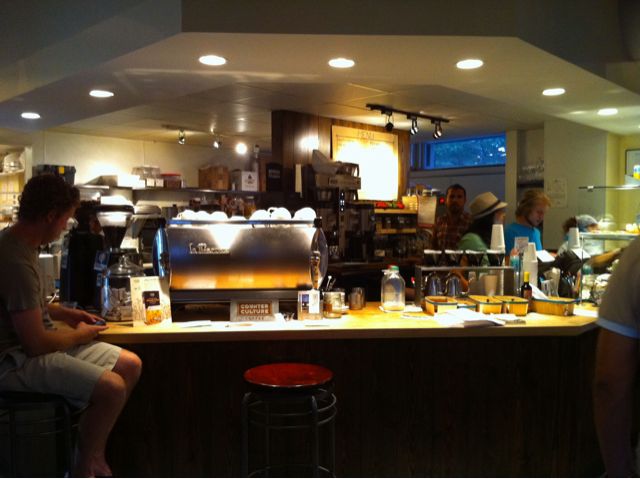
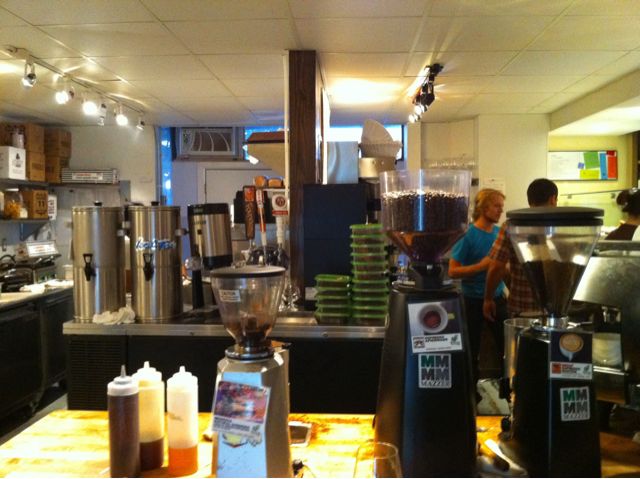
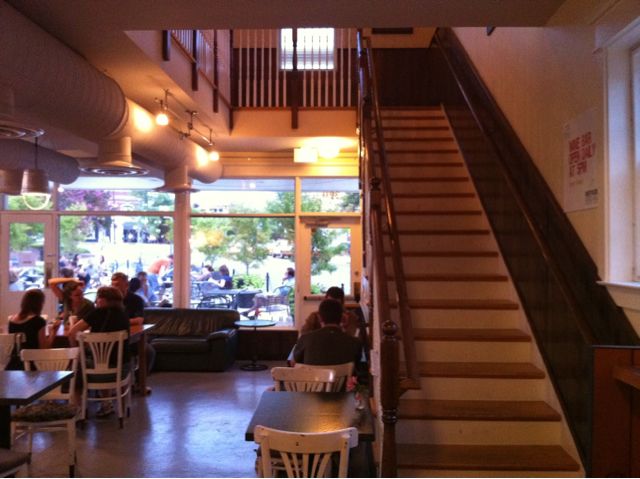
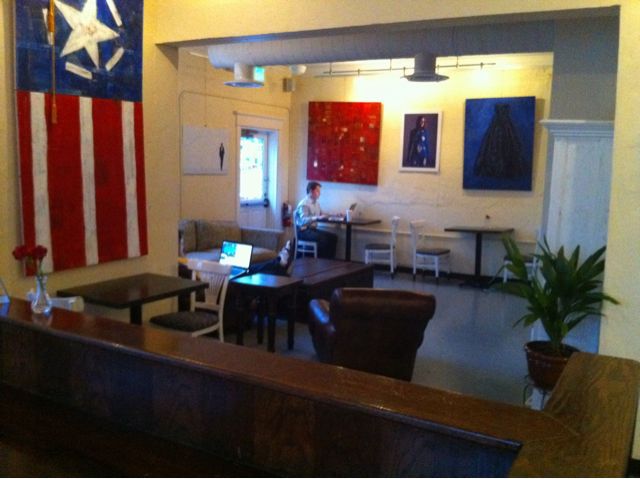
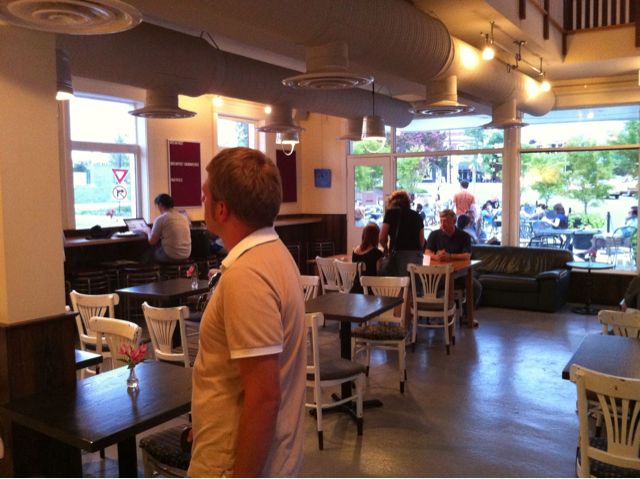
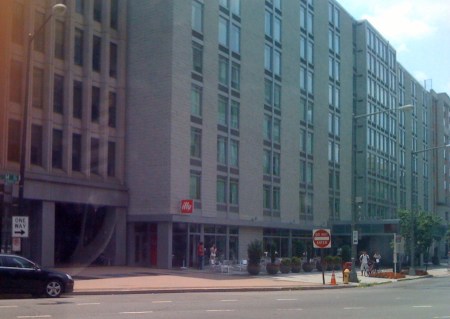
To start, the shop is a spacious old building with high ceilings, plenty of natural light on all four sides, and three separate spaces with three totally different vibes under one roof (and that isn’t even mentioning the all too rare plentiful quantity of open air seating spaces located outside all with access to their free wifi). The inside also serves as an art gallery for local artists and has tons of bar stools and counter space by the windows in addition to about a half dozen couches located throughout. Also, the kitchen is WIDE open- another uber positive sign that food is done right here.

And to think, all this before discussing the menu, the fantastic staff, the Counter Culture coffee, the splendid teas, and their homemade ICE CREAMS! According to one of the owners, who co-owns Liberty Tavern and another locale in the immediate area with his brother, the place has been open for about four months and is doing REALLY well. Well, I think it can do even better AND serve as my new favorite hangout in the area for many months to come. Below are some pictures and additional comments about the place.

My only gripe is that it was a bit difficult to bite into my grilled chicken sandwich; which was spectacularly tasty. Susana didn’t think the bread slices accompanying her salad were crunchy enough. The pastries looked wonderful and were unique – their pastry chef is top notch. The soft ice cream was outstanding – passion fruit was one of the flavors of the day. The latte art on the cappuccino was decent and the drink was made well. The espresso was made well but the single-origin Michicha from Ethiopia was not ideal as it is a sun-dried coffee that is too gnarly for my preferences as a pure espresso drink – much better as a shot in a latte. In earnest, though, I probably would have preferred a shot of a wet washed Kenya AA or a full bodied blend like the Ano Novo 2010.

So, although I can say this place is probably the best complete dining experience that I have ever had at a wine and coffee bar, it is still improving and that should scare the competition (of which there really isn’t any at this time).

Lift a glass to Northside Social in Arlington, Virginia, for they may have just hit the sweet spot for this area’s upper middle class late 20s to early 40s demographic.